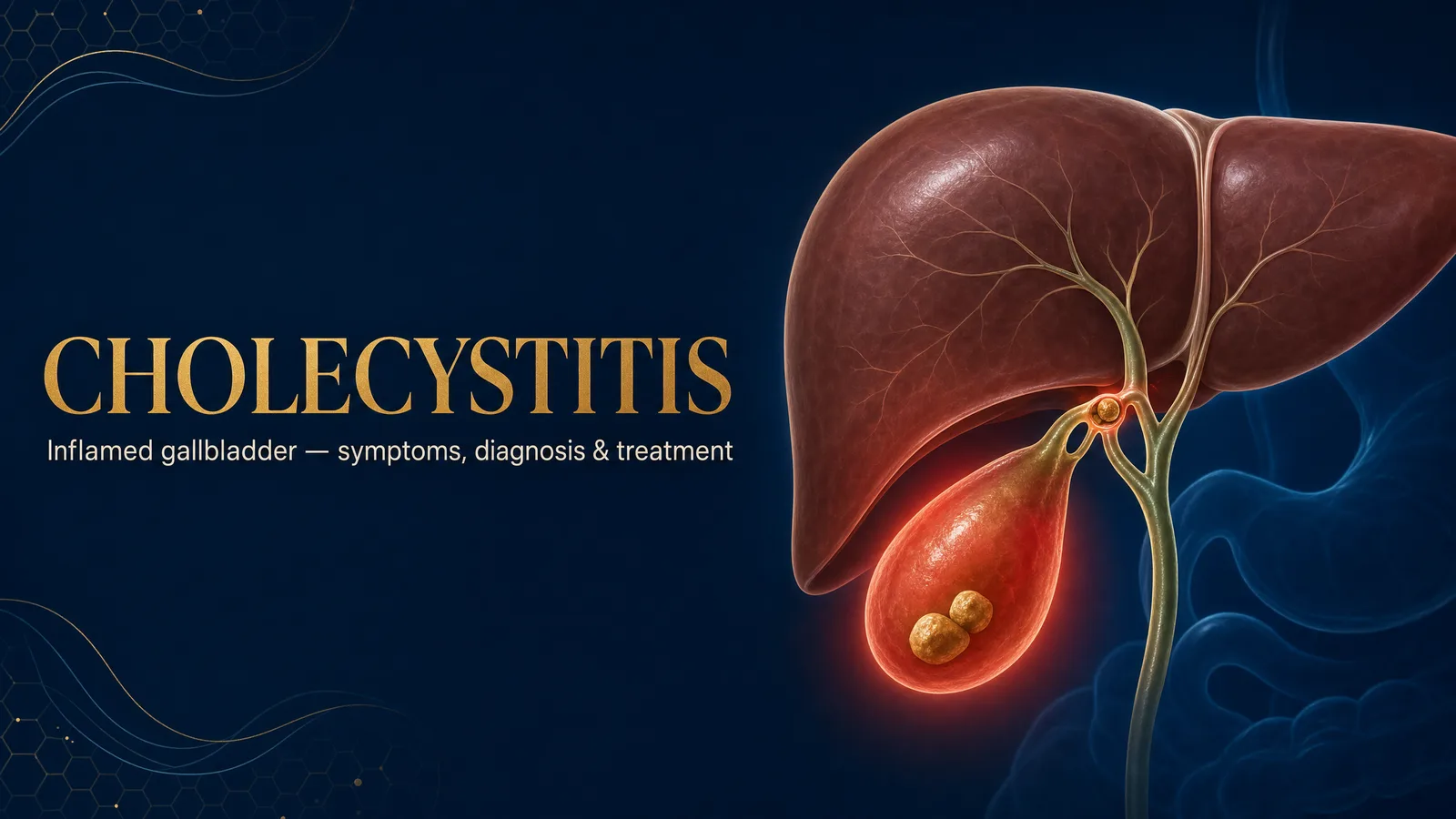
Cholecystitis means the gallbladder has become inflamed — most often because a gallstone blocks the small duct that drains it. It is not quite the same as a passing gallstone attack: in cholecystitis the gallbladder stays blocked and inflamed, so the pain is more constant, the area becomes tender, and the gallbladder can become infected. That is why cholecystitis needs prompt medical attention rather than simply waiting it out. This guide explains what cholecystitis is, how the acute and chronic forms present, how it is diagnosed, and how treatment and surgery fit in.
This is general patient education, not a diagnosis or a substitute for a consultation. It builds on our guide to biliary colic and focuses on what happens when the gallbladder becomes inflamed.
What is cholecystitis?
The gallbladder is a small pouch under the liver that stores bile. "Cholecystitis" simply means inflammation of that gallbladder. According to NHS patient guidance, it is usually caused by a gallstone blocking the cystic duct — the narrow tube through which the gallbladder empties. Bile then builds up behind the blockage, the gallbladder wall becomes irritated and swollen, and it can go on to become infected.
Gallstones are behind the great majority of cases. Less commonly, the gallbladder can become inflamed without stones (for example in people who are very unwell for other reasons), but for most patients cholecystitis is a gallstone problem — the same underlying issue we describe in our guides to gallbladder stone symptoms and what causes gallstones.
Biliary colic vs acute cholecystitis
This is the distinction that matters most, and it is worth being clear about.
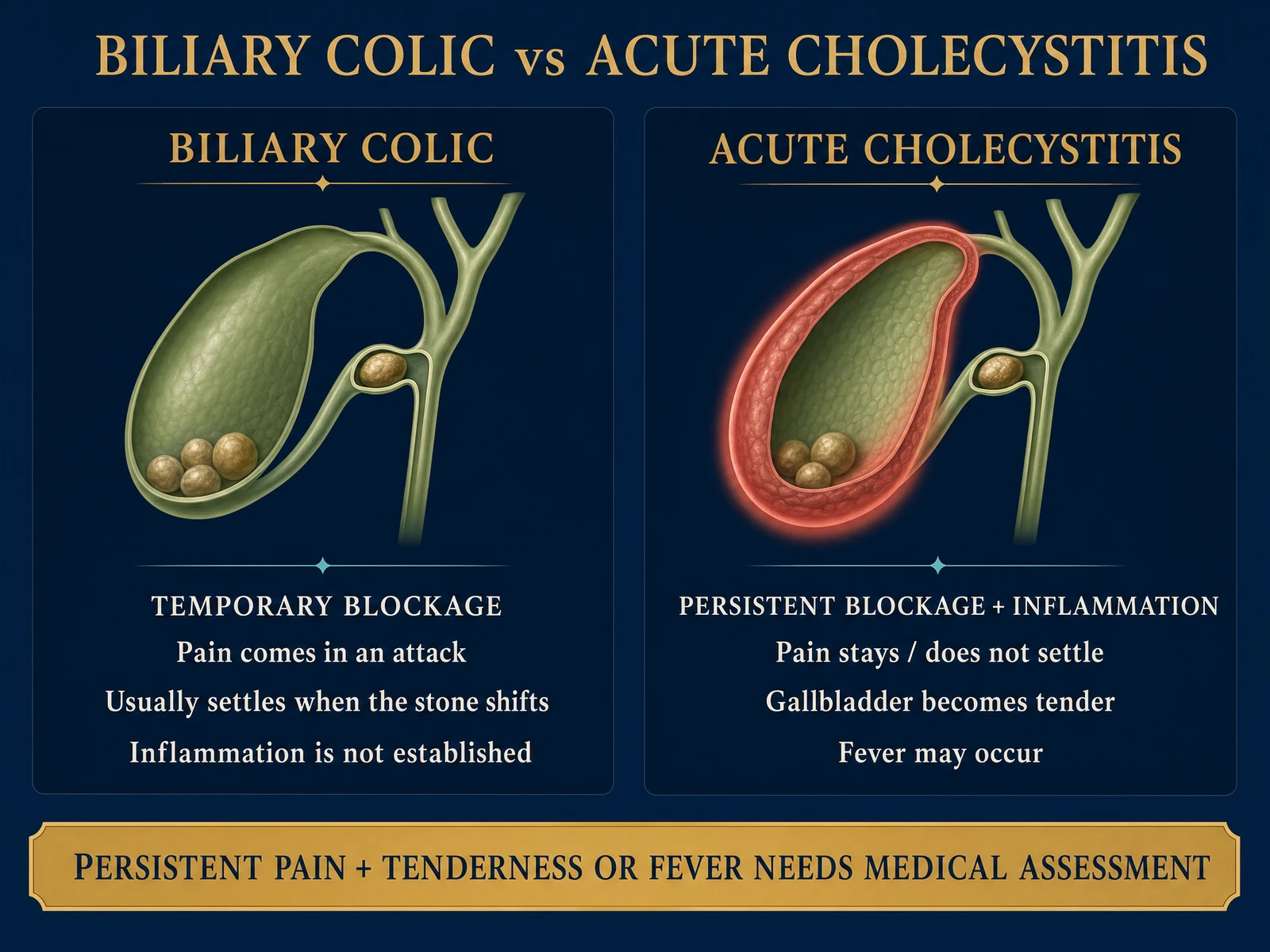
- Biliary colic happens when a gallstone temporarily blocks the gallbladder's outflow. It causes an episode of pain that builds, lasts from minutes to a few hours, and then settles once the stone shifts and the blockage relieves. Between attacks you feel well. This is the pattern we cover in detail under biliary colic.
- Acute cholecystitis happens when the blockage does not relieve and the trapped gallbladder becomes inflamed. Here the pain is more persistent, the upper-right abdomen is usually tender, and there may be a fever because inflammation — and sometimes infection — has set in.
A useful way to think about it: biliary colic is a warning that comes and goes, while acute cholecystitis is what can happen when the gallbladder stays blocked. Because the international Tokyo Guidelines for acute cholecystitis grade the illness from mild to severe, it also helps to know that cholecystitis is not one fixed thing — it ranges from a settling, mild episode to a serious illness needing urgent treatment.
Symptoms of acute cholecystitis
The hallmark of acute cholecystitis, as described by the NHS, is continuous, severe pain in the upper-right part of the tummy that may spread through to the right shoulder or shoulder blade. Alongside the pain, people often notice:
- Tenderness over the gallbladder area, so that pressing there — or even breathing in deeply — is painful.
- Nausea and vomiting.
- A high temperature (fever), sometimes with chills, reflecting inflammation or infection.
- Feeling generally unwell, and pain that is clearly not settling the way a short colic attack would.
If you have felt gallbladder attacks before, acute cholecystitis tends to feel like an attack that won't switch off. For a fuller map of where gallbladder pain is felt and how it radiates, see our guide to gallbladder pain location.
Chronic cholecystitis
Not all gallbladder inflammation is a sudden emergency. Chronic cholecystitis describes a gallbladder that has been inflamed repeatedly or over a long period, usually in the context of gallstones and recurring attacks. Over time the gallbladder wall can become thickened and scarred and may stop working as well as it should.
The symptoms are generally less dramatic than an acute attack — often recurring bouts of upper-abdominal pain or discomfort, particularly after fatty meals — rather than the intense, feverish illness of acute cholecystitis. There is no separate, exotic set of "chronic" symptoms to look out for; the key point is the pattern of repeated trouble from a diseased gallbladder. Because those attacks tend to keep coming back, chronic cholecystitis is one of the common reasons gallbladder removal is eventually recommended.
When cholecystitis becomes dangerous
Most cholecystitis is treated successfully, but it deserves respect because — if the inflamed, blocked gallbladder is left untreated — it can occasionally lead to serious complications. The NHS describes problems such as the gallbladder filling with pus (an empyema), the wall losing its blood supply and the tissue dying (gangrene), which can lead to a perforation (a burst gallbladder), a collection of infection nearby (an abscess), and — if infection spreads to the bloodstream — sepsis.
These complications are uncommon, and the point of describing them is not to alarm but to explain why cholecystitis is treated promptly rather than left to settle on its own. Recognising the warning signs (below) and getting assessed early is exactly how these outcomes are avoided.
How cholecystitis is diagnosed
Diagnosis is usually straightforward and is made from a combination of clinical assessment and simple tests. Based on NHS guidance and the Tokyo Guidelines diagnostic criteria, it typically involves:
- History and examination. Your doctor asks about the pattern of pain and examines your abdomen. A classic finding is Murphy's sign — pressing gently below the right ribs while you breathe in causes a catch of pain.
- Blood tests, which can show signs of inflammation or infection (for example a raised white-cell count or inflammatory markers).
- An ultrasound scan, which can show gallstones and a thickened, inflamed gallbladder wall. Ultrasound is the usual first-line scan.
Occasionally, further imaging (such as a CT or a specialised scan) is used if the picture is unclear or a complication is suspected — but for most people, examination, blood tests and an ultrasound are enough to make the diagnosis. This page is a patient overview, not a diagnostic checklist: the actual diagnosis is always made by the medical team assessing you.
How cholecystitis is treated
Acute cholecystitis is usually treated in hospital. Initial care, as outlined by the NHS, commonly includes:
- Resting the gut — often no food or drink for a period (nil by mouth).
- Fluids through a drip to keep you hydrated.
- Pain relief.
- Antibiotics where infection or significant inflammation is likely. The Tokyo Guidelines on antibiotic therapy treat antimicrobials as a mainstay of care when indicated, started by the team and then stepped down as you improve. Antibiotics are always prescribed and monitored by your doctors — never something to start yourself.
Supportive treatment settles the acute episode, but it does not remove the underlying problem: a gallbladder that has formed stones and become inflamed tends to cause trouble again. That is why the definitive treatment is removal of the gallbladder — a laparoscopic (keyhole) cholecystectomy. For patients who are too unwell or too high-risk for immediate surgery, the Tokyo Guidelines management flowchart describes an alternative: draining the gallbladder first (a small tube placed into the gallbladder, called a cholecystostomy) to settle the infection, with surgery planned later once the person has recovered.
Surgery and its timing
For most people, removing the gallbladder is what ultimately resolves the problem, and the operation itself is covered in our guide to laparoscopic cholecystectomy. The question patients most often ask is when surgery should happen.
Current evidence generally favours early surgery in suitable patients. A large randomised trial (the ACDC study) found that operating early led to fewer complications and a shorter hospital stay than treating with antibiotics first and operating weeks later. A Cochrane review and a more recent meta-analysis of randomised trials similarly found that early keyhole surgery is as safe as delayed surgery and shortens the total hospital stay — and importantly, the Cochrane review noted that a meaningful share of patients whose surgery was delayed needed an emergency operation before their planned date because symptoms did not settle.
That said, there is no single universal rule for exactly when to operate. As the Tokyo Guidelines flowchart makes clear, timing depends on the severity of the illness, the patient's overall fitness, and local surgical judgment and expertise — with drainage-first pathways reserved for the most severe or highest-risk cases. In practice, early surgery — often during the same illness, commonly within about a week of symptoms starting — is frequently recommended when it is safe and appropriate, but the right timing is a decision made with your surgeon.
When to seek urgent care
Cholecystitis can be serious, so knowing the warning signs matters.
Seek urgent medical assessment — do not wait it out — if you have:
- Severe or persistent upper-abdominal pain that is not settling or is getting worse
- A high temperature, fever or chills
- Yellowing of the skin or the whites of the eyes (jaundice)
- Repeated vomiting, or being unable to keep fluids down
- Feeling very unwell, faint, or confused
These can signal acute cholecystitis or one of its complications, or a related problem such as a blocked bile duct. In an emergency in the UAE, call 998 for an ambulance, or go to your nearest emergency department.
What to do next
If you have had gallbladder attacks, a diagnosis of cholecystitis, or ongoing upper-abdominal pain, the sensible step is a proper assessment — an examination and an ultrasound — to confirm what is happening and to plan treatment, including whether and when gallbladder removal is right for you.
Dr Rajarshi Mitra can review your symptoms and scans, explain your options clearly, and talk through the timing and the benefits and risks of surgery. If you would like that, you can book a consultation in Abu Dhabi. Our guides to gallbladder removal in Abu Dhabi and gallbladder surgery recovery explain what treatment and recovery involve.