If you're trying to work out whether an ache is coming from your gallbladder, this guide covers where that pain typically sits, what the pattern can tell you, and when it's a reason to seek assessment rather than wait it out. It's written for pain that is already present; if gallstones or sludge were found on a scan done for another reason and you have no symptoms, gallbladder stones in Abu Dhabi covers what an incidental finding means instead.
Where is gallbladder pain usually felt?
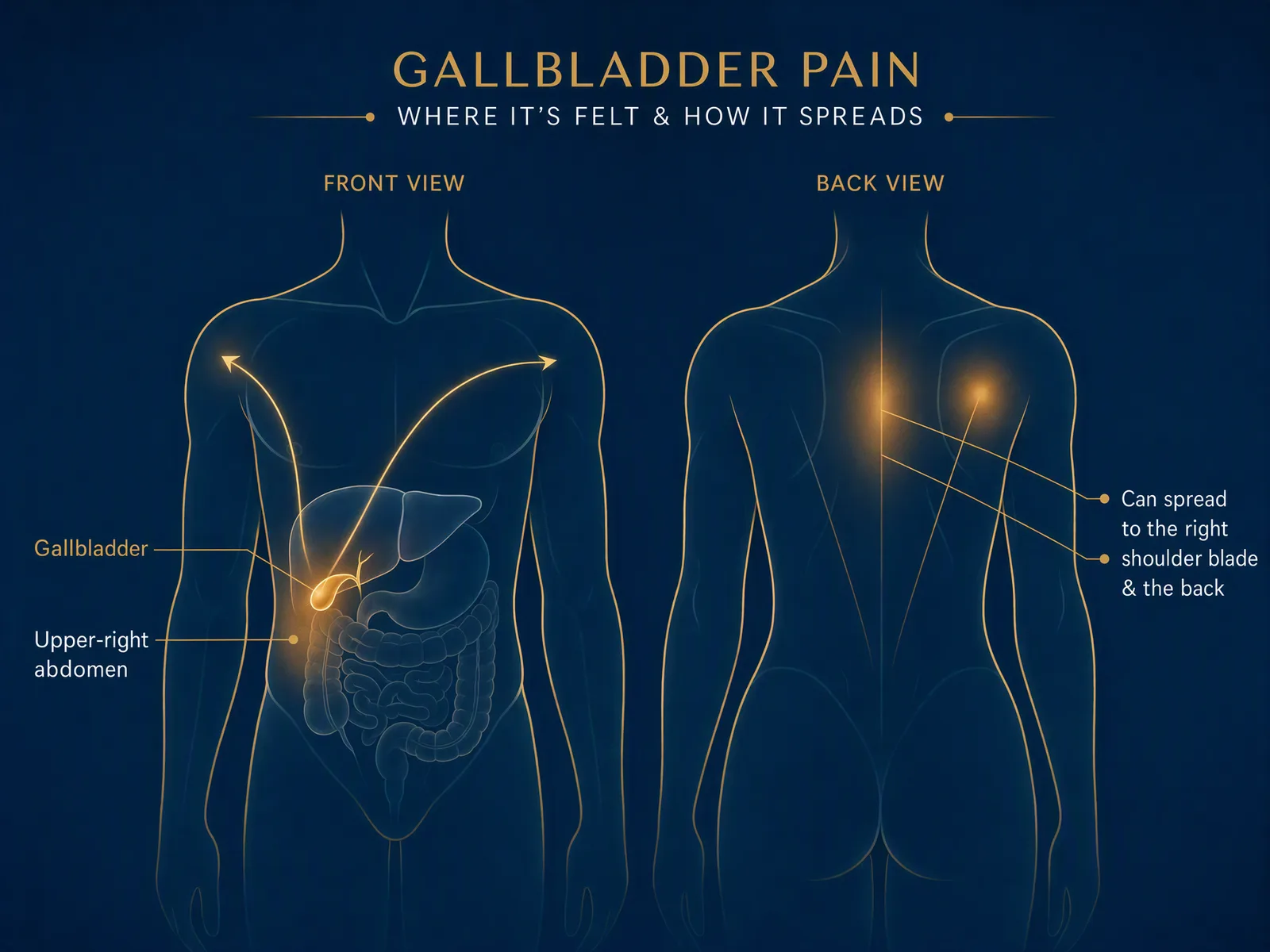
Gallbladder pain is most often felt in the upper right part of the tummy, just under the ribs. Some people feel it more in the centre of the upper abdomen instead, below the breastbone. This is the pattern most people describe during a "gallbladder attack" — the medical term is biliary colic — and it's the starting point for almost everything else in this guide.
That said, location alone doesn't confirm the cause. For the fuller picture of what an attack actually feels like — how severe it is, how long it lasts, and what tends to trigger it — see gallbladder stone symptoms, which covers that ground in more depth than this page does.
Why the pain can spread to your shoulder or back
Gallbladder pain often does not stay in one place — it can spread to the right shoulder blade or to the back between the shoulder blades.
This spreading pattern is one of the more distinctive features of gallbladder-related pain, and it's a genuinely useful clue to notice. Pain that radiates to the back or shoulder blade, on top of the location described above, points more specifically toward the gallbladder than pain that stays confined to one small spot.
A typical attack vs. pain that doesn't settle
Not every gallbladder-pain episode is the same, and how the pain behaves over time is often as informative as where it sits. A typical gallbladder attack tends to come and go — often starting after a fatty meal and settling within a few hours. Pain in the same area that does not settle, especially together with a fever, is more in keeping with gallbladder inflammation, which needs prompt assessment rather than waiting it out.
| Typical attack | Pain that doesn't settle | |
|---|---|---|
| Pattern | Comes and goes, often after a fatty meal | Persistent, may stay constant |
| Duration | Usually eases within a few hours | Continues beyond a few hours |
| Associated signs | Often pain alone, sometimes nausea | Often fever or chills |
| What it suggests | A gallbladder attack (biliary colic) | Possible gallbladder inflammation (cholecystitis) |
Two people can describe pain in exactly the same location and still need different next steps. This is why the conditions we assess overview draws a line between a typical attack and gallbladder inflammation — the location gets you to the right question, but the pattern is what helps answer it.
When pain comes with jaundice, dark urine or pale stools
Location and pattern aren't the only things to pay attention to. If pain in this area comes together with yellowing of the skin or eyes (jaundice) or with dark urine or pale stools, this can mean a stone has moved into the bile duct — this combination needs prompt medical assessment.
This is a different situation from a typical gallbladder attack. A stone that has moved out of the gallbladder and into the bile duct is what this combination of signs can point to — a reason to be seen promptly rather than to wait and see whether the pain settles by itself.
Can you have this pain without gallstones?
Not everyone with this kind of pain has gallstones — sometimes the gallbladder itself is not emptying normally even though no stones are seen on a scan. This is called a functional gallbladder disorder, and it is still assessed and treated seriously.
In other words, a clear ultrasound doesn't automatically rule out the gallbladder as the source of pain in this location. If your pain matches the pattern described above but a scan hasn't shown stones, raise it at an assessment rather than assuming the gallbladder has been ruled out.
What else could cause pain in this same area?
Pain in this part of the tummy is not always the gallbladder — problems with the stomach, kidneys or even the muscles of the abdominal wall can feel similar. An assessment is the only reliable way to know what is actually causing it.
A few broad categories can feel similar:
- Stomach-related causes — problems in the stomach can also cause upper-abdominal discomfort.
- Kidney-related causes — a kidney problem on the right side can be felt in a similar part of the body.
- Muscle-related causes — a strained muscle in the abdominal wall can mimic the same general area.
None of this is a checklist to diagnose yourself with. It's simply a reminder that "pain in this area" and "gallbladder pain" aren't automatically the same thing, and that an assessment is what actually tells the two apart.
When to seek urgent care
See a doctor urgently if pain in this area comes together with any of these:
- Yellowing of the skin or eyes (jaundice)
- Fever or chills
- Dark (tea-coloured) urine or pale stools
- Abdominal pain — especially in the upper right or central abdomen — that is severe or does not settle
In an emergency in the UAE, call 998 or go to the nearest emergency department.
What to do next
If your pain matches the typical, episodic pattern described above and has settled each time, it's worth mentioning at a routine assessment rather than waiting indefinitely, particularly if it happens again. Before a consultation, it helps to bring:
- Any ultrasound or scan report you already have.
- A note of when the pain occurs (for example, after meals or at night), how long it lasts, and whether — and where — it spreads.
- Any of the associated signs described above: jaundice, dark urine, pale stools, fever or chills.
If your pattern matches the urgent-care signs above, don't wait for a scheduled appointment — seek prompt care instead. For everything else, a consultation can review your symptoms and scan findings together, and — if surgery becomes relevant — your gallbladder surgery journey explains what that involves. If you would like this looked at, you can book a consultation in Abu Dhabi.