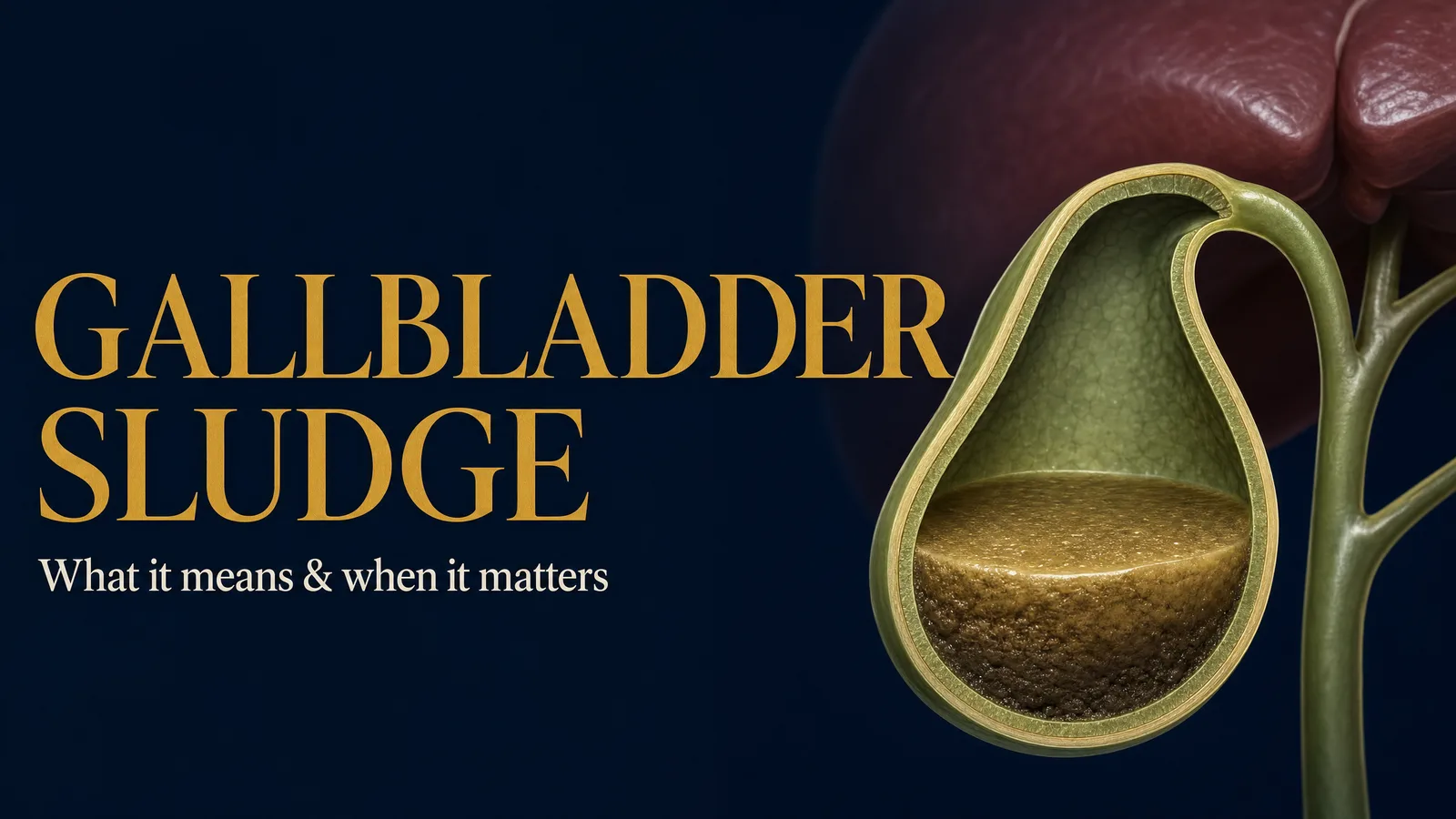
Gallbladder sludge is a thick mixture that can build up in bile inside the gallbladder. Finding out you have it can sound alarming, but sludge often causes no symptoms at all, and many people only learn they have it when a scan is done for an unrelated reason. This guide explains what gallbladder sludge is, what tends to happen to it over time, the warning signs that need urgent attention, and when watchful waiting versus surgery is the right conversation to have.
What is gallbladder sludge?
Gallbladder sludge, also called biliary sludge, is a mixture of particulate material that can accumulate in bile within the gallbladder. It's made up of tiny cholesterol crystals, a bile pigment called calcium bilirubinate, and mucin, a mucus-like material. Rather than a single hard stone, it's a thicker mixture of these components suspended in the bile.
Is gallbladder sludge serious?
Not necessarily. Gallbladder sludge is frequently asymptomatic, and it's often found incidentally on imaging performed for another reason — for example, an abdominal ultrasound done as part of an unrelated health check. An incidental finding like this doesn't automatically mean treatment is needed. What matters is whether sludge is causing symptoms or has led to a complication; the sections below cover both the natural course of sludge and the warning signs worth knowing.
What happens to gallbladder sludge over time?
The natural history of gallbladder sludge is variable, and there's no way to predict in advance which path a given person will follow. In broad terms, gallbladder sludge can:
| Outcome | What it means |
|---|---|
| Resolve spontaneously | The sludge clears on its own, with no further findings on later imaging |
| Remain unchanged | The sludge is still present on follow-up imaging but hasn't caused symptoms or complications |
| Progress to gallstones | The sludge develops into actual gallstones over time |
This is why an isolated finding of sludge is usually approached calmly rather than treated as an emergency. If sludge does progress to actual gallbladder stones, the symptom pattern to watch for is the same one covered in a dedicated gallstone symptoms guide, currently in preparation — the warning signs below apply regardless of whether sludge or a stone is behind them. See the watchful-waiting section below for how the treatment decision is actually made.
Why does gallbladder sludge form?
Gallbladder sludge formation is linked to the gallbladder not emptying as efficiently as usual, or to changes in the balance of substances within bile — doctors refer to this general process as bile stasis. This is a mechanism, not a full list of triggers: a dedicated guide to the fuller gallstone causes and risk-factor picture is in preparation.
How is gallbladder sludge diagnosed?
Gallbladder sludge is typically identified using abdominal ultrasound — the same imaging method used to evaluate the gallbladder for gallstones and related conditions. Ultrasound findings like this are then interpreted alongside your symptoms and history, not read in isolation.
Can gallbladder sludge cause complications?
Gallbladder sludge and microlithiasis (very small stone-like particles) are recognised as a possible cause of acute pancreatitis, a painful inflammation of the pancreas, in some patients. Sludge is also linked to cholecystitis, inflammation of the gallbladder itself, when it contributes to a blockage — a condition covered in more depth in a dedicated guide currently in preparation. Neither of these outcomes is inevitable; they're part of why sludge that is causing symptoms is taken seriously rather than dismissed, not a reason for alarm about a single incidental finding.
Watchful waiting or surgery: how the decision is made
If sludge isn't causing any problems, watchful waiting is often a reasonable approach — there's no need to rush into treatment for an asymptomatic, incidental finding. If sludge is associated with symptoms or has led to a complication, the treatment discussed is usually the same standard treatment used for symptomatic gallstones: surgical removal of the gallbladder (cholecystectomy), most often performed laparoscopically. This page keeps that at a decision-stage level; if surgery becomes the path ahead, the gallbladder surgery journey walks through what to expect from consultation through recovery.
Does diet get rid of gallbladder sludge?
There's no reliable evidence that diet alone dissolves or eliminates existing gallbladder sludge, and no diet should be relied on as a treatment for sludge that's already there. That said, addressing reversible contributing factors — such as resuming a normal, regular eating pattern after a period of rapid weight loss or prolonged fasting — is a sensible general habit, though it isn't a guaranteed way to make existing sludge go away. Sludge that is causing symptoms still needs medical assessment rather than a dietary fix.
Gallbladder sludge care in Abu Dhabi: getting the right assessment
If you've been told you have gallbladder sludge — whether it turned up incidentally or alongside symptoms — the next step is an evaluation with a doctor, not a decision made from a search result. Dr Rajarshi Mitra is a DOH-licensed laparoscopic surgeon consulting at NMC Specialty Hospital, Abu Dhabi. Bringing your ultrasound report to that first conversation helps make it a productive one; if you're insured through Daman, Thiqa, Mednet or Nextcare, the practice has a network relationship with these insurers, though this website cannot promise approval — that decision always rests with the insurer. For a full picture of Dr Mitra's background and credentials, see about Dr Mitra.
Related reading
For a full picture of gallstones themselves — what they are, why they form, and how they're treated — see gallbladder stones in Abu Dhabi. If surgery is the recommended next step, the gallbladder surgery journey explains what to expect. For an overview of every gallbladder condition Dr Mitra treats, see gallbladder conditions.