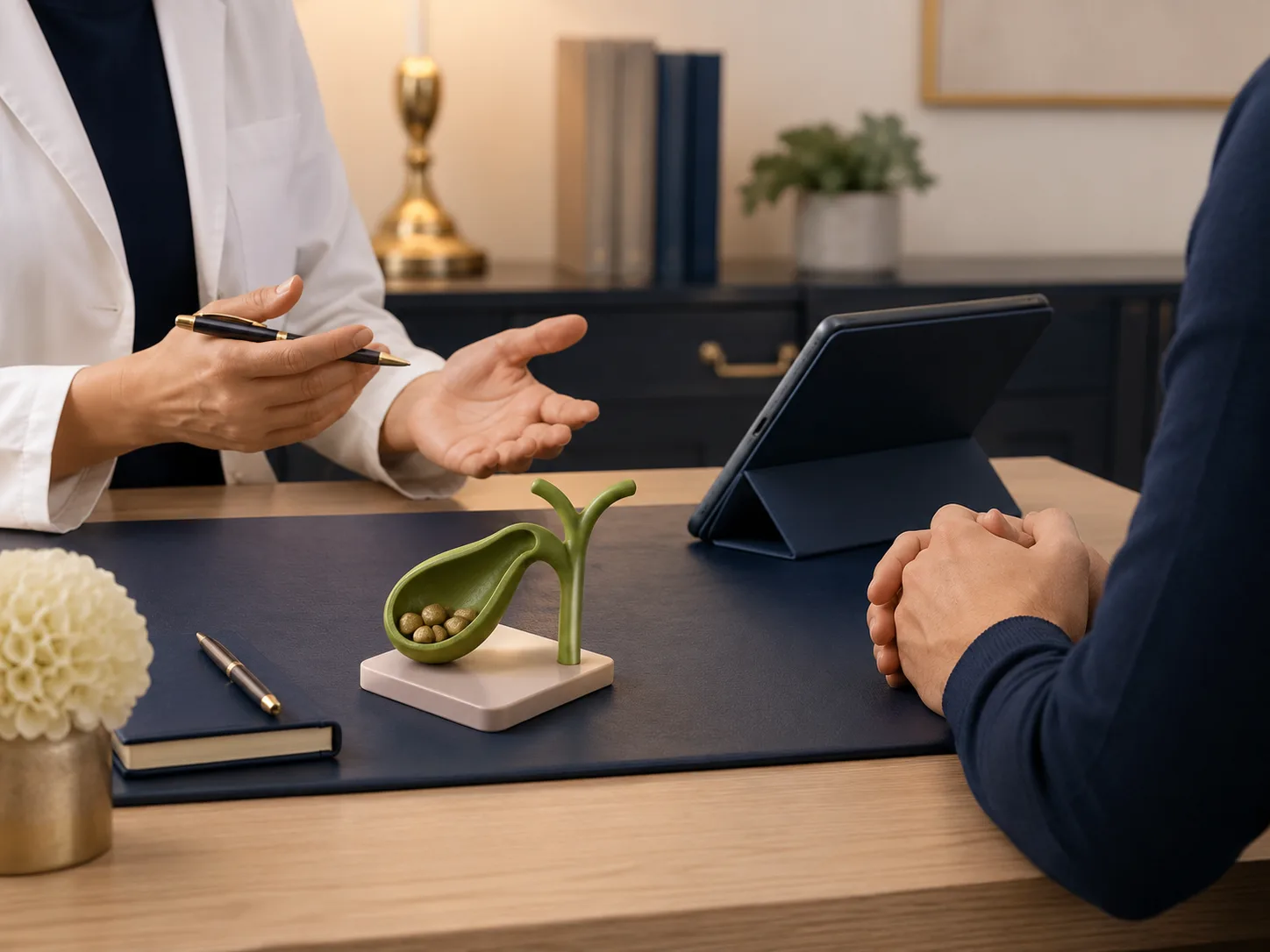
Gallbladder stones — gallstones — are hard deposits that form inside the gallbladder from substances in bile, most often cholesterol and sometimes bilirubin (pigment stones). They are common, and many people who have them never know it. This guide explains what gallstones are, why they form, when they're safe to simply watch, the warning signs that need urgent attention, and what treatment looks like once stones are causing problems.
What are gallbladder stones?
Gallbladder stones, also called gallstones, are hard deposits that form inside the gallbladder from substances in bile — most often cholesterol, and sometimes bilirubin (pigment stones). They range in size from a grain of sand to a golf ball, and a person can have one stone or many. The gallbladder itself is a small organ that stores and concentrates bile, which the body uses to digest fat; when the balance of substances in that bile shifts, or the gallbladder isn't emptying efficiently, stones can form.
Are gallbladder stones serious? (Silent stones and incidental findings)
Not necessarily. Many people with gallstones never notice any symptoms and only find out they have them when a scan is done for an unrelated reason. These are sometimes called "silent" stones, and an incidental finding like this doesn't automatically mean treatment is needed — see the treatment section below for how that decision is usually approached.
When stones do cause symptoms, they typically present as attacks of upper-abdominal pain, often after a fatty meal. That symptom pattern — including how long an attack usually lasts and what else can accompany it — is covered in full in gallbladder stone symptoms; this page stays focused on the stones themselves rather than repeating that depth here.
What causes gallstones?
Gallstones form from an imbalance in bile, or from the gallbladder not emptying efficiently. Recognised risk factors for developing gallstones include increasing age, female sex, obesity or rapid weight loss, pregnancy, and a family history of gallstones. Rapid weight loss deserves a specific mention here: it's a general risk factor regardless of how the weight loss happens, and that includes newer weight-loss medications — the evidence specific to those medications is covered separately in weight loss injections and gallstone risk.
This overview covers the general risk-factor picture only. A dedicated guide to the fuller causes and prevention picture is in preparation.
What happens if gallstones are left untreated?
If a stone blocks a duct, it can lead to recognised complications such as inflammation of the gallbladder (cholecystitis), a stone becoming stuck in the bile duct (choledocholithiasis), or inflammation of the pancreas (pancreatitis). Each of these is its own condition with its own diagnosis and treatment path, which this page doesn't go into step by step — the point here is simply that untreated, symptomatic gallstones can progress to something that needs more urgent care.
Long-standing gallstone disease is also a recognised risk factor for gallbladder cancer, although gallbladder cancer itself is rare. This is one general point worth being aware of, not a reason for alarm about a single finding of gallstones.
How are gallbladder stones treated? (Watchful waiting vs. surgery)
Gallstones that are not causing symptoms often do not require immediate treatment, and a watch-and-wait approach is a recognised option — this is why an incidental finding on a scan doesn't automatically mean surgery is next.
For gallstones causing symptoms or complications, surgical removal of the gallbladder (cholecystectomy) — most often performed laparoscopically — is the standard recommended treatment per current clinical practice guidelines. This page keeps that at a decision-stage level; if surgery is the path ahead for you, the gallbladder surgery journey walks through what to expect from consultation through recovery. Dedicated guides to the procedure itself and to the recovery timeline in detail are both in preparation.
Gallbladder stones in Abu Dhabi: getting the right care
If you have gallbladder stones — whether found incidentally or because of symptoms — the next step is an evaluation with a doctor, not a decision made from a search result. Dr Rajarshi Mitra is a DOH-licensed laparoscopic surgeon consulting at NMC Specialty Hospital, Abu Dhabi. Bringing your ultrasound report and insurance details to that first conversation helps make it a productive one; if you're insured through Daman, Thiqa, Mednet or Nextcare, the practice has a network relationship with these insurers, though this website cannot promise approval — that decision always rests with the insurer.
If cost and returning to work are your main questions, a dedicated cost and insurance guide is in preparation. For a full picture of Dr Mitra's background and credentials, see about Dr Mitra.
Related reading
For the full range of gallbladder-attack symptoms and when they need urgent attention, see gallbladder stone symptoms. If weight loss is part of your picture, weight loss injections and gallstone risk explains that specific evidence. For an overview of every gallbladder condition Dr Mitra treats, see gallbladder conditions. If surgery is the recommended next step, the gallbladder surgery journey explains what to expect.