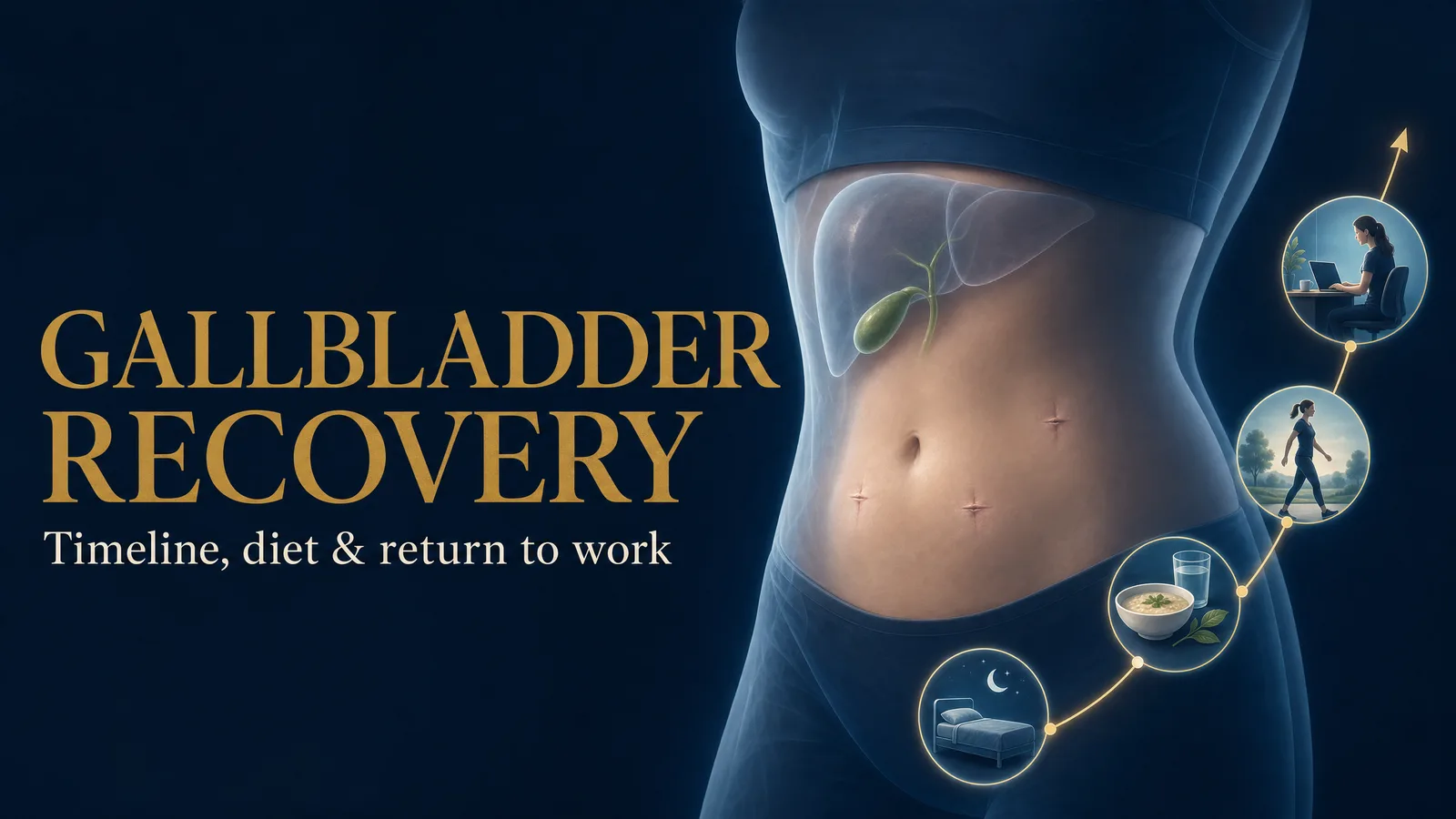
Most people recover from gallbladder removal (cholecystectomy) faster than they expect — but "how long" depends far more on the type of operation and your job than on whether you are a man or a woman. After keyhole (laparoscopic) surgery, many people are back to light activity within a few days and to normal routines within about two weeks. After open surgery, recovery usually takes longer — often six to eight weeks. This guide explains what a typical recovery feels like day by day, what to eat, when it is usually safe to drive, exercise and return to work, and which symptoms mean you should call your surgeon rather than wait.
Recovery after gallbladder removal is gradual and individual. After laparoscopic (keyhole) surgery, most people go home within 24 hours when medically appropriate, manage discomfort with simple pain relief, and resume desk work in roughly one to two weeks. Open surgery, or surgery complicated by infection or a difficult gallbladder, usually needs six to eight weeks. Early on, expect some incision soreness, shoulder-tip discomfort from surgical gas, tiredness, bloating and looser stools. These usually settle. Sex alone does not set your timeline — the surgical approach, your general health, pain control and how physical your work is matter much more. Fever, worsening pain, jaundice or persistent vomiting are not part of normal recovery and need prompt review.
- Recovery speed is driven mainly by the type of surgery (keyhole versus open) and any complications — not by sex.
- After keyhole surgery, light activity often resumes within days; desk workers commonly return in one to two weeks.
- Open surgery or a complicated operation usually needs about six to eight weeks before full activity.
- Temporary bloating, loose stools and food intolerance are common early on and usually improve with a lighter, lower-fat approach that you gradually broaden.
- Fever, worsening or severe pain, jaundice, persistent vomiting or spreading wound redness need urgent medical review.
What "recovery" actually means after gallbladder removal
Your gallbladder stores bile between meals. When it is removed, the liver still makes bile — it simply flows more continuously into the intestine. Most people digest normally without a gallbladder, though some notice temporary changes in the first weeks.
Two things shape your recovery more than anything else. The first is the surgical approach. Laparoscopic (keyhole) cholecystectomy uses a few small incisions and is by far the most common technique; recovery is generally quicker with less pain. Open surgery uses a larger incision and is chosen when the operation is complex — for example with severe inflammation, scarring, or when the anatomy cannot be seen safely. A small number of keyhole operations are converted to open during surgery for safety reasons, which is a sound surgical decision rather than a complication in itself.
The second factor is you: your age, general health, weight, whether you smoke, conditions such as diabetes, and how physically demanding your daily life and work are. These matter more than gender. It is a common online myth that women recover on a different timeline from men; the evidence does not support treating sex as the deciding factor. Your operation type, pain control, and job demands are what set the pace.
Recovery timeline, stage by stage
Everyone heals at their own rate. The stages below describe a typical, uncomplicated laparoscopic recovery, with notes on how open surgery differs.
| Stage | Keyhole (laparoscopic) | Open surgery |
|---|---|---|
| First 24 hours | Often discharged the same day or next day when medically appropriate; walking encouraged early | Usually a longer hospital stay of several days |
| First week | Incision soreness, shoulder-tip pain from gas, tiredness; short walks daily | More soreness; mobility slower but still encouraged |
| Weeks 2–4 | Many resume most normal activities and light exercise | Gradual return to light activity |
| Weeks 4–8+ | Full activity for most people | Heavier tasks and full exercise typically by 6–8 weeks |
The first 24 hours. Early gentle walking is usually encouraged to reduce the risk of clots and help the gas used during keyhole surgery disperse. Discharge within 24 hours is common after an uncomplicated keyhole operation when your surgical team judges it appropriate.
The first week. Expect soreness around the small incisions and, often, an aching pain at the tip of one shoulder — this comes from residual gas irritating the diaphragm and settles over a few days. Fatigue and mild bloating are normal. Keep moving in short, frequent bouts rather than staying in bed.
Weeks two to four. Energy and stamina return for most people having keyhole surgery, and everyday activities feel manageable. Build activity up gradually rather than in one leap.
Longer recovery. Open surgery, a difficult or complicated operation, or an infection all extend the timeline, commonly to six to eight weeks for full activity. Slower recovery is not a personal failing — it usually reflects the operation, not effort.
Eating after gallbladder surgery
You can generally return to eating soon after surgery, starting light. In the first days and weeks, some people get looser stools, bloating, or discomfort after fatty or greasy meals, because bile now flows continuously rather than being released in a concentrated burst. This usually eases as your digestion adjusts.
A practical approach for the early weeks:
- Start with smaller, more frequent meals rather than large ones.
- Favour lighter, lower-fat foods at first, then broaden your diet as your symptoms allow.
- Reintroduce richer or fattier foods gradually, noticing which ones you tolerate.
- Stay hydrated, especially if stools are loose.
Importantly, a permanent, strict low-fat diet is not required for most people. Online sources often overstate lifelong fat avoidance. The sensible pattern is symptom-guided: eat lighter while things settle, then widen your diet. If loose stools or food intolerance persist beyond the early weeks, that is worth discussing with your doctor, as simple treatments can help.
Returning to work, driving and exercise
There is no single date that fits everyone, because return depends on your operation, pain, medication and how physical your work is.
Desk and office work. Many people who had keyhole surgery feel ready for sedentary work within about one to two weeks, sometimes sooner, provided pain is controlled and they are not taking sedating pain medicine.
Physically demanding work. Jobs involving heavy lifting, bending or long periods on your feet usually need longer — often several weeks, and longer again after open surgery. Rushing back to heavy work too soon risks strain around healing incisions.
Driving. Wait until you can move comfortably, brace and turn without hesitation, perform an emergency stop, and are no longer taking sedating pain medication. For many people after keyhole surgery this is a matter of days to a week, but there is no fixed rule — comfort and reaction time decide.
Exercise. Gentle walking from day one is encouraged. Build up light activity over the first couple of weeks, and delay heavy lifting and strenuous exercise until you are comfortable and cleared — commonly around four to six weeks, longer after open surgery.
If you are in Abu Dhabi and need documentation, ask your surgical team about a medical certificate for time off and about the follow-up appointment before you are discharged. Because job demands and workplace rules vary, your operating surgeon's advice for your situation takes priority over any general timeline.
When to call your surgeon urgently
Some discomfort, tiredness, shoulder-tip pain and mild bowel changes are expected. Certain symptoms are not, and they can signal infection, a bile leak, bleeding or another problem that needs prompt attention.
Contact your surgical team promptly, or seek urgent medical care, if you have any of the following after gallbladder surgery:
- Fever or chills
- Worsening or severe abdominal pain rather than gradually improving soreness
- Yellowing of the skin or eyes (jaundice), or dark urine and pale stools
- Persistent vomiting or being unable to keep fluids down
- Increasing redness, swelling, warmth or drainage from a wound
- Chest pain or shortness of breath
In a medical emergency in the UAE, call 998 for an ambulance. Do not wait to see whether severe or rapidly worsening symptoms settle on their own — it is always reasonable to have them checked.
Follow-up and planning your recovery at home
A little preparation makes the first week easier. Before discharge, it helps to confirm a few practical points with your team: how to care for your wounds, what pain relief to take, when your follow-up appointment is, and which symptoms should prompt a call.
Arrange for someone to drive you home and, ideally, to stay with you for the first day or two after day surgery. Set up easy, lighter meals in advance, keep essentials within easy reach so you avoid heavy lifting, and plan short, regular walks. Give yourself permission to rest — fatigue in the first week is normal, not a setback.
If you would like tailored guidance about your recovery, a consultation can address your specific operation, health and work situation.