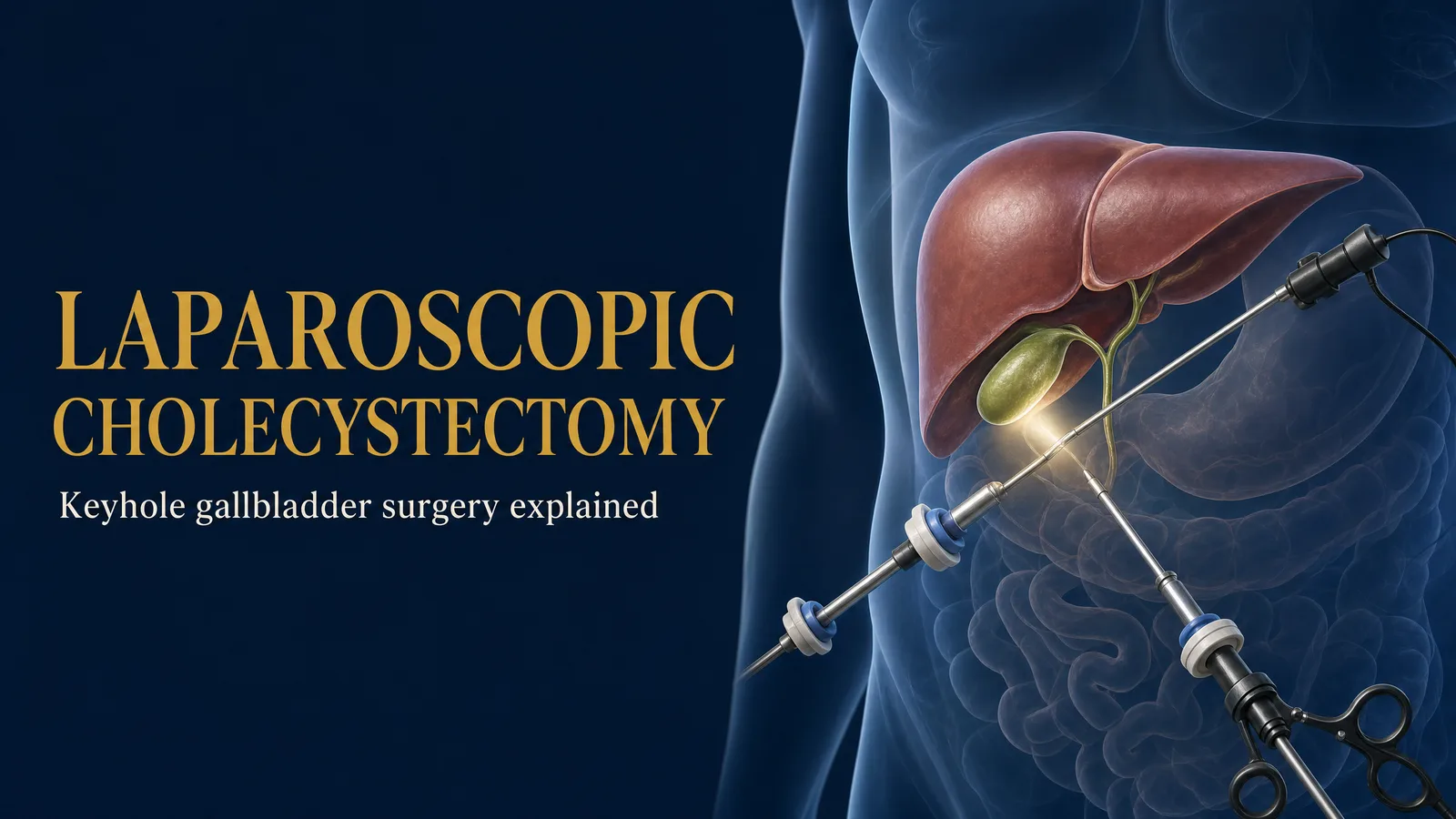
Laparoscopic cholecystectomy is the standard, minimally invasive operation to remove the gallbladder — done through a few small cuts using a camera and fine instruments rather than one large incision. It is one of the most common operations in the world, and for most people it means going home the same day or the next, with less pain and a faster recovery than older open surgery. This guide explains, in plain language, what the operation is, why it is done, how it is carried out, its risks, and what recovery usually looks like.
This is general patient education, not a surgical manual or a substitute for a consultation. It builds on our overview of gallbladder removal in Abu Dhabi and focuses on the operation itself.
What laparoscopic cholecystectomy is
"Cholecystectomy" simply means removing the gallbladder. "Laparoscopic" — often called keyhole surgery — means it is done through several small cuts rather than one large one, guided by a tiny camera. The keyhole approach is the main method used to remove the gallbladder, and it is a well-established, minimally invasive and predictably safe operation.
One point often surprises people: the operation removes the whole gallbladder, not just the stones inside it. That is deliberate — a gallbladder that has formed stones tends to keep causing problems, and the liver continues to make bile perfectly well without it.
Why it is done
The operation is usually recommended for gallbladder problems that are causing symptoms or complications. In practice the large majority of operations are for gallstones, and typical reasons include:
- Symptomatic gallstones causing repeated pain after meals — the pattern we describe in our guide to biliary colic.
- Cholecystitis — inflammation or infection of the gallbladder.
- Gallstone-related complications, such as certain bile-duct or pancreas problems, in appropriate situations.
- Gallbladder polyps where removal is indicated on their size or features.
Not every gallstone needs surgery — the decision depends on your symptoms, scans and overall health, which is exactly what a consultation is for.
How it is done — a step-by-step overview
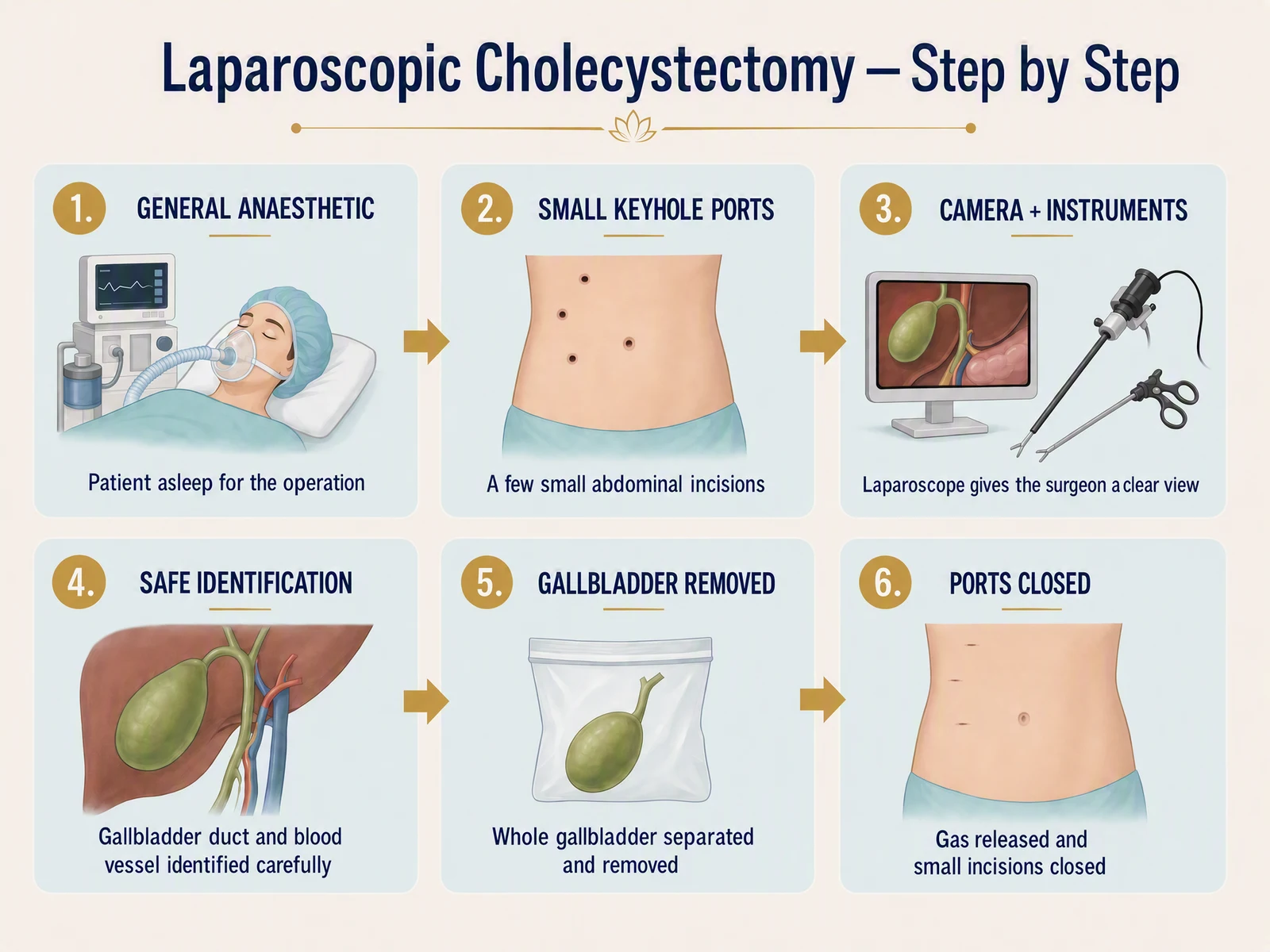
This is a high-level, patient-friendly outline of what happens during a keyhole gallbladder removal — not a surgical instruction set. Based on NHS patient guidance, the operation usually goes as follows:
- General anaesthetic. You are fully asleep for the whole operation.
- Small cuts. The surgeon makes a small cut near the navel and a few more on the upper-right side of the tummy — commonly around four small incisions in total.
- Inflating the abdomen. Gas (carbon dioxide) is gently pumped in to create space, so the surgeon can see and work safely.
- Camera and instruments. A thin tube with a camera — the laparoscope — is passed through one cut, and fine instruments through the others. The view is shown on a screen.
- Careful identification. Before anything is divided, the surgeon takes time to clearly identify the gallbladder, its duct and its blood vessel. This deliberate step — known as the critical view of safety — is a key part of doing the operation safely.
- Removing the gallbladder. The gallbladder is separated from the liver and lifted out through one of the small cuts.
- Closing up. The gas is released and the small cuts are closed with stitches or dressings.
The operation itself usually takes about an hour, though it can take longer if the gallbladder is badly inflamed or scarred.
Benefits of the keyhole approach
Compared with traditional open surgery — which uses one larger incision — the laparoscopic approach generally offers:
- Smaller cuts and smaller scars.
- Less pain afterwards and a quicker, easier recovery; open surgery involves more post-operative pain and a longer recovery.
- A shorter hospital stay — often a day-case procedure, with around 85% of planned keyhole removals going home the same day, and typical stays of only a day or so.
- A faster return to normal activity.
These are general patterns, not guarantees — your own recovery depends on your health, your job and how the operation goes.
Risks and complications
Laparoscopic cholecystectomy is considered a safe, routine operation, but — like any surgery — it carries some risks, and it is fair to know them. Most are uncommon. Recognised complications include:
- Wound infection and bleeding, usually minor.
- A bile leak after surgery.
- Gallstones left in the bile duct, which may need a further procedure to remove.
- Injury to the bile duct or nearby structures — a serious but uncommon complication. In large studies the risk of a bile-duct injury needing surgical repair with the laparoscopic approach is roughly 1 to 4 in 1,000 operations (about 0.2% to 0.4%).
- Anaesthetic-related risks, which are low for most people.
Your surgeon will explain the risks that are most relevant to your particular situation, and the careful identification step described above is one of the ways these risks are kept low.
When open surgery is needed
Sometimes a keyhole operation is safely converted to open surgery — a single larger incision — partway through. This is only done when needed, typically when the gallbladder is very inflamed, badly scarred, or the anatomy is unclear, and it is a sensible safety decision rather than a failure or a mistake.
Conversion is not common — in one large series about 3 in 100 operations — and it is more likely with certain factors, such as acute (severe) cholecystitis, older age, male sex, obesity, diabetes, or previous surgery in the upper abdomen. If your surgeon converts to open surgery, it means they judged it the safest way to complete your operation.
Recovery — what to expect
Most people recover quickly and simply. In brief, you can usually expect:
- A short stay — often home the same day or the next.
- Some soreness, bloating and trapped wind for a few days, and sometimes shoulder-tip discomfort from the gas used during surgery.
- Early gentle movement, building up activity gradually.
- A gradual return to work — often within one to two weeks, depending on your job.
Our dedicated guide to gallbladder surgery recovery covers the timeline, wound care and returning to work in detail, our 7-day gallbladder diet menu helps with easing back into eating, and gallbladder removal side effects explains the longer-term digestive changes some people notice.
When to seek urgent care
Most recovery is uneventful, but a few symptoms need prompt medical attention rather than waiting.
Seek urgent medical assessment if, after surgery, you develop:
- A high temperature, fever or chills
- Severe or worsening tummy pain
- Yellowing of the skin or the whites of the eyes (jaundice)
- Repeated vomiting, or being unable to keep fluids down
- A wound that becomes increasingly red, swollen, hot or leaks fluid
- Shortness of breath, or a swollen, hard, very tender abdomen
In an emergency in the UAE, call 998 for an ambulance, or go to your nearest emergency department.
What to do next
If gallstones or gallbladder pain are affecting your life, the sensible step is an assessment to see whether surgery is the right option for you — and, if it is, to have your questions about the operation answered properly.
Dr Rajarshi Mitra can review your symptoms and scans, explain what laparoscopic cholecystectomy would involve in your case, and talk through the benefits and risks. If you would like that, you can book a consultation in Abu Dhabi.