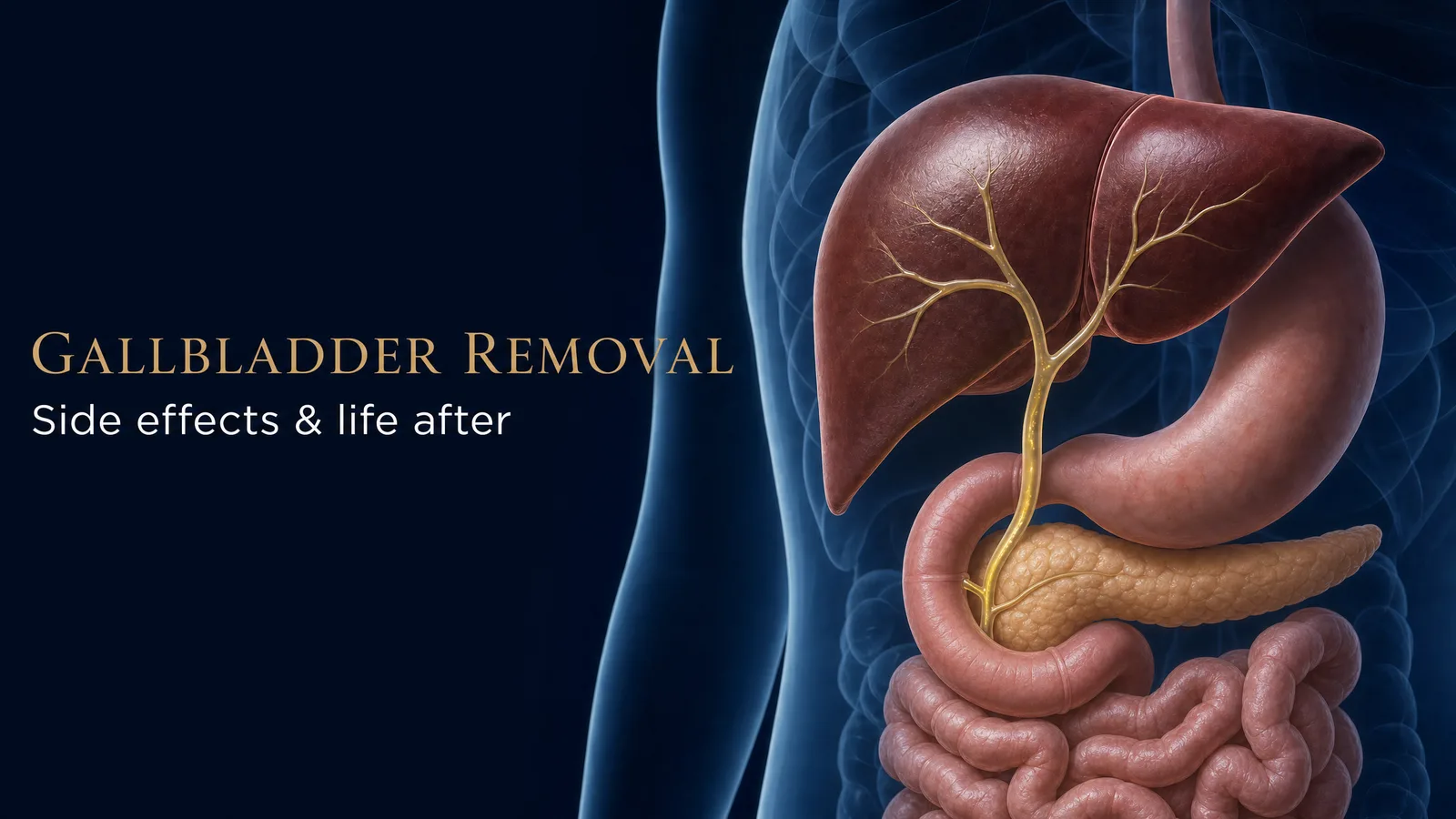
If you are facing gallbladder surgery, or have just had it, the honest headline is reassuring: most people live and digest food normally without a gallbladder. Temporary digestive changes — looser stools, bloating, a bit of discomfort after fatty meals — are common in the first few weeks and settle for the great majority. A smaller number of people have longer-lasting symptoms, most often loose stools, that can be assessed and treated. Knowing which changes are expected, which fade, and which deserve a doctor's attention is what this guide is for.
This is general education, not personal medical advice. It builds on our guide to gallbladder removal in Abu Dhabi and focuses on one question: what actually happens to your body, in the short and long term, after the gallbladder is gone.
What happens to digestion without a gallbladder
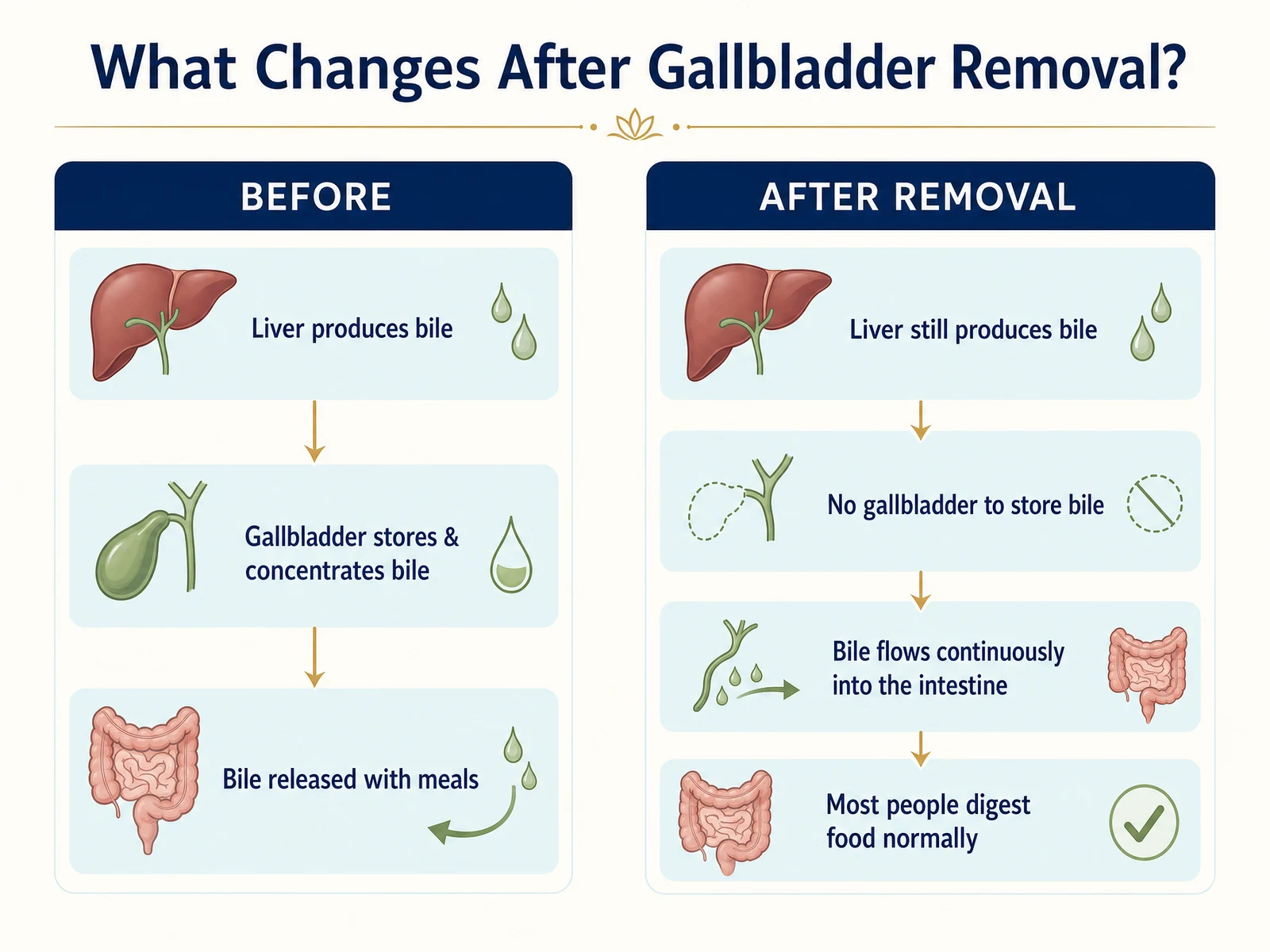
The single most useful thing to understand is what the gallbladder actually did. Your liver makes bile continuously — the gallbladder never produced it. The gallbladder was simply a storage pouch that held and concentrated bile between meals, then squeezed it out when a fatty meal arrived.
When the gallbladder is removed, the liver carries on making bile exactly as before. The difference is timing: instead of being released in a concentrated burst after meals, bile now drips more continuously down the bile duct into the small intestine. For most people the intestine adapts to this within weeks, and digestion continues normally. In a minority, that steadier flow of bile reaching the bowel is what drives the loose stools discussed below. This is why the changes people notice are almost always about bowel habit and fatty-food tolerance, not an inability to digest food at all.
Common short-term side effects
In the first days to weeks after keyhole (laparoscopic) surgery, some effects are expected parts of recovery rather than true "side effects of having no gallbladder":
- Wound and tummy pain around the small incisions, easing over several days.
- Bloating and trapped wind, and sometimes shoulder-tip pain, from the gas used to inflate the abdomen during keyhole surgery.
- Nausea and a reduced appetite for a short while.
- Looser or more frequent stools.
- Tiredness as you recover.
These are common and usually short-lived. In one prospective study, symptoms after keyhole gallbladder removal were reported by more than half of patients in the first week but only around 13% by six months — a clear settling pattern. Our gallbladder surgery recovery guide covers the healing timeline in detail.
Diarrhoea and bowel changes
Looser stools are the side effect people ask about most. After gallbladder removal, bile reaches the intestine more steadily, and in some people the extra bile acids arriving in the lower bowel draw in water and speed things up — a pattern doctors call bile acid diarrhoea. It tends to show up as urgency or loose stools, sometimes after fatty meals.
The important context is that for most people this improves over weeks to months as the body adjusts. It is not something everyone gets, and it is not a life sentence. Where symptoms do persist, they are treatable: medicines that bind bile acids (bile acid sequestrants such as cholestyramine or colesevelam) help a large proportion of people, alongside simple dietary steps. Bile acid diarrhoea is often under-recognised, so if loose stools are not settling, it is worth raising specifically with your doctor rather than putting up with it.
Diet and fatty foods
Many people find greasy, very fatty or spicy meals harder to tolerate in the early weeks, which fits the change in how bile is delivered. The practical approach is to eat smaller, balanced meals at first and reintroduce fattier foods gradually as your system adjusts.
Most people do not need a permanent low-fat or special diet after gallbladder removal — long-term rigid fat restriction is not routinely necessary. Our 7-day gallbladder diet menu gives a practical way to ease back into normal eating rather than a diet you must follow forever.
Long-term effects and common myths
In the longer term, the majority of people eat and digest normally and get on with life without a gallbladder. A few points are worth clearing up, because the internet is full of overstated claims:
- Weight: gallbladder removal does not, by itself, force inevitable weight gain or loss. Any change usually reflects what and how you eat and your activity during recovery, not the surgery alone.
- Liver damage: removing the gallbladder does not damage the liver, which continues making bile as it always did.
- Vitamins and nutrition: routine vitamin deficiency or an inability to absorb food is not an expected consequence, and most people do not need permanent digestive enzyme supplements.
If you develop genuinely new or persistent digestive problems long after surgery, that deserves assessment on its own merits rather than being assumed to be a permanent "no-gallbladder" state.
Persistent or returning pain
Some people still have upper-abdominal pain, indigestion or discomfort after surgery. When symptoms persist or come back, doctors use the umbrella term post-cholecystectomy syndrome — but it is important to understand that this describes a set of symptoms, not one single disease.
The causes are varied. A systematic review found that many are extra-biliary — problems such as acid reflux or other digestive conditions that may have been present before surgery and were never actually due to the gallbladder. Others relate to the biliary system itself: a later cause can be a stone left behind in, or forming within, the common bile duct. In a large share of people, no single cause is found. The practical takeaway is that persistent pain should be investigated rather than assumed — and not automatically blamed on the operation.
Side effect vs complication — how to tell them apart
It helps to separate three different things, because they are not the same:
- Expected recovery symptoms — wound soreness, bloating, trapped wind, tiredness — that fade over days to weeks.
- Persistent functional changes — mainly looser stools or fat sensitivity — that affect a minority and can be managed.
- Complications — uncommon problems that need medical attention.
Recognised complications of the operation, though most are uncommon, include a wound infection, bleeding, a bile leak, injury to the bile duct or nearby organs, and a retained gallstone in the bile duct causing pain or jaundice. These are handled proportionately by your surgical team — the point here is simply that a complication behaves differently from ordinary recovery, usually with more severe, worsening or new symptoms rather than the steady improvement you would expect.
When to seek urgent care
Most recovery is uneventful, but some symptoms need prompt medical assessment rather than watchful waiting.
Seek urgent medical assessment if, after gallbladder surgery, you develop:
- Severe or worsening tummy pain
- A high temperature, fever or chills
- Yellowing of the skin or the whites of the eyes (jaundice), dark urine or pale stools
- Repeated vomiting, or being unable to keep fluids down
- A wound that becomes increasingly red, swollen, hot or leaks fluid
- A swollen, hard or very tender abdomen
In an emergency in the UAE, call 998 for an ambulance, or go to your nearest emergency department.
What to do next
Most people leave their gallbladder behind and barely think about it again. If you are weighing up surgery, or you have had it and something does not feel right — stubborn loose stools, or pain that will not settle — the sensible step is a proper assessment rather than guesswork.
Dr Rajarshi Mitra can talk through what to expect after gallbladder removal, review any symptoms you are having, and arrange the right tests if persistent problems need looking into. If you would like that, you can book a consultation in Abu Dhabi.