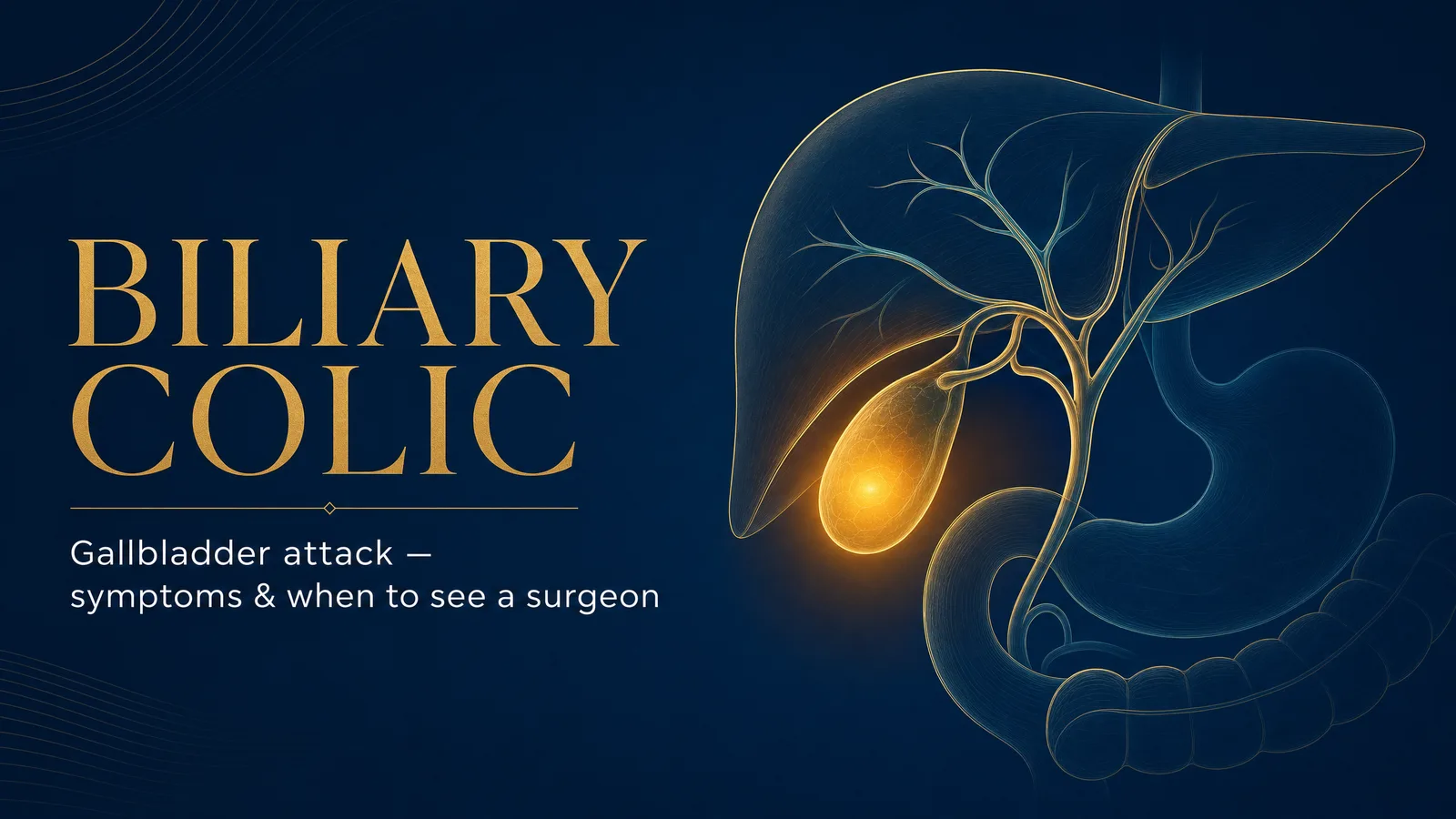
Biliary colic is the medical name for a gallbladder attack: a bout of pain that happens when a gallstone briefly blocks the outflow of bile from your gallbladder. The pain usually builds in the upper-right or upper-middle part of your tummy, often after a fatty or heavy meal, and then eases again over the next half hour to a few hours. On its own, an attack is not an infection — but pain that will not settle, or that comes with a fever or yellowing of the skin, is a warning sign that needs to be checked urgently.
This guide explains what an attack feels like, how it is different from a gallbladder emergency, how it is diagnosed, and how to decide when it is time to talk to a surgeon here in Abu Dhabi. It is general education, not a diagnosis — only a consultation can tell you what is causing your own symptoms.
What biliary colic actually is
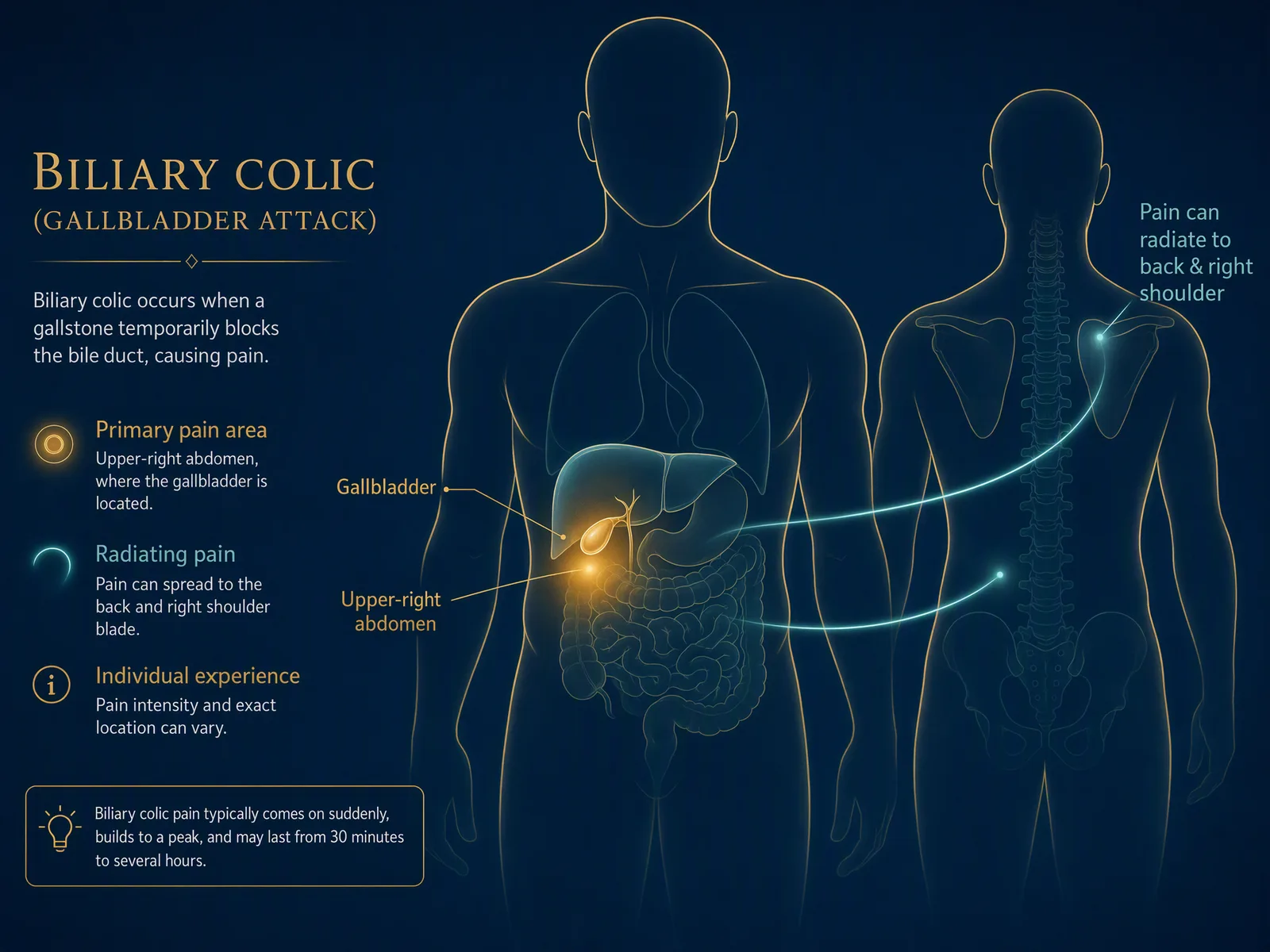
Your gallbladder is a small pouch under the liver that stores bile and squeezes it into the intestine to help digest fat. When a gallstone temporarily lodges in the narrow duct that drains the gallbladder, pressure builds up and you feel pain. When the stone slips back or passes, the pressure is released and the pain fades. Doctors call this pattern biliary colic, and it is the usual first sign of symptomatic gallstones.
The word "colic" can be misleading — the pain is often steady rather than coming in sharp waves. What makes it colic is that it comes and goes as episodes, rather than being constant. Between attacks, most people feel completely normal.
What a biliary colic attack feels like
A typical attack has a recognisable pattern:
- Where: the upper-right or upper-middle (the doctors call this the epigastrium) part of the abdomen. The pain can spread to the back or the right shoulder blade.
- When: often 30–60 minutes after a fatty or large meal, and it commonly wakes people in the evening or at night.
- How long: usually from about half an hour up to a few hours — often in the range of one to five hours — before it gradually settles.
- What else: feeling sick, restlessness, or sweating during the attack is common.
Everyone is a little different, so the exact spot and length can vary. If you want a fuller picture of the wider range of gallstone symptoms, our guide to gallbladder stone symptoms covers them in more detail.
How biliary colic is different from a gallbladder emergency
This is the most important distinction to understand. Uncomplicated biliary colic is a temporary blockage that settles. A gallbladder emergency is when a stone causes ongoing blockage or infection — for example acute cholecystitis (an inflamed gallbladder), a stone stuck in the main bile duct, cholangitis (an infected bile duct), or gallstone pancreatitis. These complications behave differently: the pain does not settle, and the body starts to show signs of infection or jaundice.
When to seek urgent care
Get urgent medical assessment — do not wait to see whether it settles on its own — if a gallbladder attack comes with any of these:
- Pain that lasts more than a few hours or keeps getting worse
- A high temperature, fever or chills
- Yellowing of the skin or the whites of the eyes (jaundice)
- Dark urine or unusually pale stools
- Repeated vomiting, or being unable to keep fluids down
These can be signs of an inflamed or infected gallbladder or a blocked bile duct, which need prompt treatment. In an emergency in the UAE, call 998 for an ambulance, or go to your nearest emergency department.
Why biliary colic happens
Almost all biliary colic is caused by gallstones. Some people are more prone to forming them than others — factors include age, weight, rapid weight change, family history, and hormonal factors. We cover the full picture separately in what causes gallstones. The key point for this page is that the pain is a mechanical event: a stone getting in the way of bile flow, not the gallbladder "acting up" at random.
How doctors confirm it
If your story sounds like biliary colic, the first and most reliable test is an ultrasound scan of the upper abdomen, which reliably shows gallstones and is painless and quick. Occasionally other scans (such as an MRCP) are added if a stone in the bile duct is suspected. Blood tests may be done to check for signs of infection or a blocked duct.
Managing an attack and preventing the next one
There are two separate questions: how to settle an attack now, and how to stop attacks coming back.
During an attack, treatment is about pain relief. Anti-inflammatory painkillers (NSAIDs) are often effective when they are safe for you, alongside anti-sickness medication if needed.
To prevent further attacks, the definitive treatment for recurring biliary colic is keyhole (laparoscopic) removal of the gallbladder, called a cholecystectomy. It is the standard treatment for symptomatic gallstones and is frequently carried out as a day case. You can read what the operation involves in our guide to gallbladder removal in Abu Dhabi, and what to expect afterwards in gallbladder surgery recovery.
What about medication instead of surgery? Medicines such as ursodeoxycholic acid, which can slowly break some cholesterol stones down, have only limited and uncertain benefit and are generally reserved for people who are not suitable for an operation. They are not a reliable substitute for surgery, and stones often return when the medicine stops.
It is also worth saying clearly: not every gallstone needs an operation. Many people have stones that never cause symptoms and can simply be watched. The decision to operate is an individual one, weighing how often attacks happen, how severe they are, and your general health.
When to see a surgeon in Abu Dhabi
A good rule of thumb: if you have had more than one clear biliary colic attack, it is worth a surgical consultation — even if you feel well between episodes — because attacks tend to recur and can occasionally lead to the complications described above. You should seek advice sooner if attacks are becoming more frequent or more severe.
A consultation is a conversation, not an automatic booking for surgery. Dr Rajarshi Mitra will review your history and ultrasound, explain your options plainly, and help you decide whether watchful waiting or planned keyhole surgery makes more sense for you. If you would like to talk it through, you can book a consultation and bring your ultrasound report and insurance details if you have them.