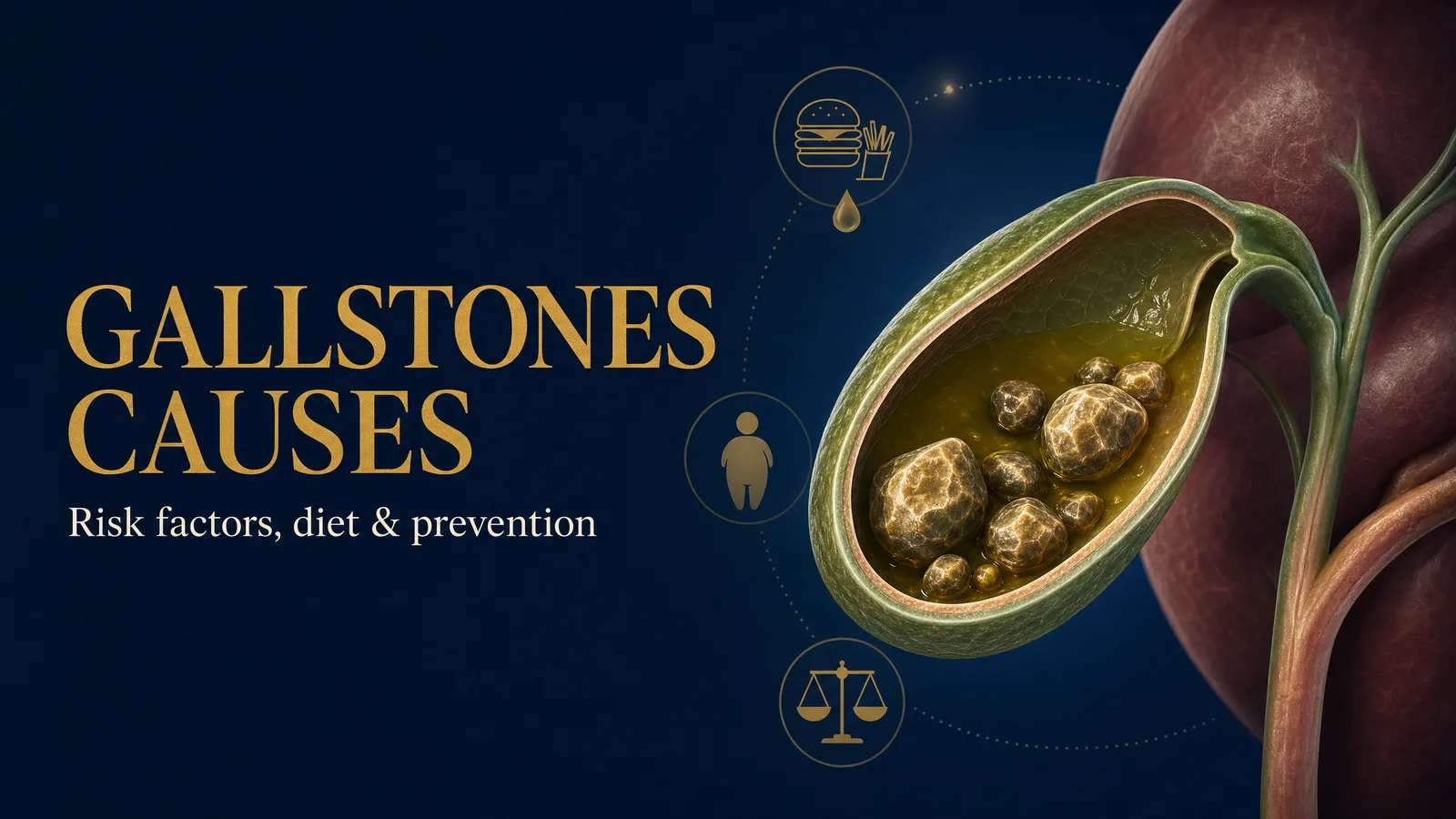
If you have just been told you have gallstones — or you are trying to avoid them — the natural first question is why. Gallstones form when the chemistry of bile, the fluid your gallbladder stores to help digest fat, tips out of balance. Most are made largely of cholesterol. Whether you develop them comes down to a mix of things you cannot change, such as age and family history, and things you can influence, such as weight and diet. The reassuring part is that gallstones are common, most never cause any trouble, and while nothing can guarantee you will never get them, there are sensible steps that lower the odds. This guide explains how gallstones form, what raises the risk — including why the picture is so relevant here in the UAE — and what genuinely helps.
How do gallstones actually form?
Bile is a greenish-yellow fluid made by the liver and stored in the gallbladder. After a meal, the gallbladder squeezes bile into the intestine to help break down fat. Bile is a careful mixture of cholesterol, a pigment called bilirubin, and bile salts that keep everything dissolved. Gallstones develop when that mixture is thrown off balance — most often when bile holds too much cholesterol, too much bilirubin, or not enough bile salts to keep them dissolved. When that happens, tiny crystals can settle out and, over time, clump together into stones ranging from a grain of sand to several centimetres across.
There is a second part to the picture. Gallstones can also form when the gallbladder does not empty as fully or as often as it should. Bile that sits for too long becomes thick and over-concentrated, which makes crystals more likely to form. This is why stones tend to build up gradually rather than appear overnight.
Cholesterol stones and pigment stones
There are two main types of gallstone. Cholesterol stones are by far the most common. They develop when the liver releases more cholesterol into bile than the bile can keep dissolved — so the surplus starts to crystallise. Because they are driven largely by the balance of cholesterol and by how well the gallbladder empties, cholesterol stones are the type most closely linked to weight, diet and the risk factors below.
Pigment stones are less common and form when there is too much bilirubin in bile. Bilirubin is a waste product from the normal breakdown of red blood cells, and it can build up in certain situations — for example some blood disorders that break down red cells faster than usual, liver cirrhosis, or particular bile-duct conditions. According to reviews retrieved from PubMed, these pigment stones account for a smaller share of cases than cholesterol stones (Lammert et al., Nature Reviews Disease Primers, 2016; Stinton & Shaffer, Gut and Liver, 2012).
What raises your risk of gallstones?
Gallstones are common: reviews retrieved from PubMed estimate that as many as one in five adults develops them at some point, though only a minority ever go on to have symptoms or complications (Lammert et al., 2016). Risk comes from a combination of factors. Some you cannot change; several you can influence.
| Risk factors you cannot change | Risk factors you can influence |
|---|---|
| Getting older — risk rises after about age 40 | Carrying excess weight (overweight or obesity) |
| Being female | Losing weight very quickly (crash diets, after weight-loss surgery) |
| A family history of gallstones | A diet high in fat and low in fibre |
| Your ethnic background | Being physically inactive |
| Higher oestrogen — pregnancy, and some hormone therapies | Type 2 diabetes and metabolic syndrome |
A few of these deserve a word of explanation. Gallstones are more common in women, partly because higher oestrogen — during pregnancy, and with some forms of hormone therapy or the contraceptive pill — raises the amount of cholesterol in bile. This is an association to be aware of, not a reason to stop any medication your doctor has prescribed.
Weight matters in both directions. Carrying excess weight increases the cholesterol in bile, while losing weight very quickly also raises the risk, because rapid loss changes the balance of bile and can trigger stone formation. That includes crash diets and the period after weight-loss surgery — and it is a general effect of rapid weight loss however it happens. If weight-loss medication is part of your situation, the specific evidence is covered separately in weight-loss injections and gallstone risk.
Finally, several medical conditions add to the risk — including type 2 diabetes, Crohn's disease, liver cirrhosis, and disorders that break down red blood cells. Obesity, type 2 diabetes and metabolic syndrome are especially relevant because they share the same underlying pathway of insulin resistance, and together they are established risk factors for cholesterol gallstones (Lammert et al., 2016; Stinton & Shaffer, 2012).
Why gallstones matter in the UAE
This risk-factor picture is particularly relevant in the UAE. The country has high rates of obesity and type 2 diabetes — both established risk factors for cholesterol gallstones — which means the conditions that push bile out of balance are common in the local population. That does not mean everyone here will develop gallstones, and there is no reliable figure for exactly how common stones are in the UAE specifically. The practical takeaway is simpler: the same steps that help with weight and metabolic health also happen to lower gallstone risk, so they are doubly worthwhile.
Can you lower your risk? Diet and lifestyle
You cannot control your age, sex or family history, and no approach removes the risk entirely. But because so much of gallstone risk is tied to weight and metabolic health, the factors you can influence genuinely matter. Evidence reviews retrieved from PubMed point to a consistent, sensible set of measures (Stokes & Lammert, Visceral Medicine, 2021; Lammert et al., 2016):
- Keep to a healthy weight — and if you need to lose weight, aim for steady, gradual loss rather than a crash diet.
- Avoid very rapid weight loss. Where fast weight loss is medically necessary or expected, your doctor can advise on how to reduce the added gallstone risk during that period.
- Stay physically active. Regular activity supports weight control and is linked with lower gallstone risk.
- Eat a balanced diet with plenty of fibre — vegetables, fruit, wholegrains and pulses — while keeping saturated fat moderate.
It is worth being clear about what diet can and cannot do. Eating well influences your chance of forming stones; it is not a way to get rid of stones you already have. Despite popular claims online, no food, drink or "detox" regimen has been shown to clear gallstones once they have formed. If you already have stones, the questions that matter are whether they are causing symptoms and what to do about them — not which juice to try.
When do gallstones need looking at?
Most gallstones are "silent": they cause no symptoms and are often found by chance on a scan done for another reason. Silent stones usually need no treatment at all. When stones do cause trouble, the typical sign is a "gallbladder attack" — a bout of upper-abdominal pain, often after a fatty meal. The full symptom pattern, and how to tell it apart from ordinary indigestion, is covered in gallbladder stone symptoms.
If gallstones are causing repeated symptoms, it is worth being assessed. Whether any treatment is needed — and, if so, whether that means keyhole gallbladder surgery — is an individual decision made after your symptoms, scans and general health have been reviewed. It is never automatic, and many people with gallstones never need surgery at all. For the bigger picture of the condition, see the full guide to gallbladder stones; if surgery does become relevant, the gallbladder surgery journey explains what to expect.
Getting assessed in Abu Dhabi
If you have gallstones — found by chance or because of symptoms — the useful next step is an evaluation with a doctor rather than a decision made from a search result. Dr Rajarshi Mitra is a DOH-licensed laparoscopic surgeon consulting at NMC Specialty Hospital, Abu Dhabi. Bringing your ultrasound report and insurance details to that first conversation helps make it productive; if you are insured through Daman, Thiqa, Mednet or Nextcare, the practice has a network relationship with these insurers, though approval always rests with the insurer and cannot be promised here. For Dr Mitra's background, see about Dr Mitra, and for an overview of every gallbladder condition assessed here, see gallbladder conditions.