If you are a woman with upper-tummy pain or unexplained nausea, it is natural to wonder whether it is your gallbladder — and whether gallstone symptoms are somehow different for women. The honest answer is reassuring: in women, gallstone symptoms usually follow the same classic pattern seen in other adults. What more clearly differs is risk — pregnancy, the hormone oestrogen and some metabolic factors make gallstones genuinely more common in women. This guide explains what to look for, why women are more prone to gallstones, and when tummy pain needs urgent attention.
This is general patient education, not a diagnosis or a substitute for a consultation. It builds on our broader guide to gallbladder stone symptoms and focuses on the questions women most often ask.
Do gallstone symptoms differ in women?
This is the question behind most searches — and it deserves a careful answer. Authoritative descriptions of gallstone symptoms describe the same core pattern regardless of sex: pain in the upper-right or upper-central abdomen, often after fatty food, sometimes with nausea. There is no separate, female-only set of symptoms to look out for.
Where sex genuinely matters is in how likely gallstones are to form in the first place. Female sex is one of the well-recognised risk factors for gallstones, alongside age and family history, in the epidemiology of gallbladder disease. So the useful way to think about it is: a woman is more likely than a man to develop gallstones, but once symptoms appear, they tend to look much the same. That is why the rest of this guide covers both the typical symptoms and the reasons women are more prone to them.
What gallbladder symptoms feel like
When a gallstone temporarily blocks the flow of bile, it causes a recognisable kind of pain. According to NIDDK patient guidance, typical gallstone pain:
- is felt in the upper-right or upper-central part of the tummy;
- can last from a few minutes to a few hours;
- is sometimes accompanied by nausea or vomiting.
The NHS describes this "gallbladder attack" (biliary colic) as sudden, steady and often severe pain that can be triggered by a fatty meal and may spread through to the back or up to the right shoulder blade. It usually settles again once the stone shifts. Many people notice the attacks come and go, often in the evening or overnight.
Because this pain sits high in the abdomen, it is easy to mistake for indigestion, reflux or a "bad stomach" — which is exactly why recurring attacks are worth investigating rather than simply enduring. For a fuller picture of where the pain is felt and how it radiates, see our guide to gallbladder pain location, and for the anatomy of an attack, biliary colic.
When there are no symptoms at all
Not every gallstone causes trouble. Many gallstones cause no symptoms at all — so-called silent stones — and are found only by chance on a scan done for another reason. Both NIDDK and the NHS make this point clearly.
This matters because finding a gallstone does not automatically mean you need surgery. Stones that have never caused symptoms are often simply monitored. The decision to treat depends on your symptoms, your scans and your overall health — which is what an assessment is for, not something a website can decide for you.
Why gallstones are more common in women
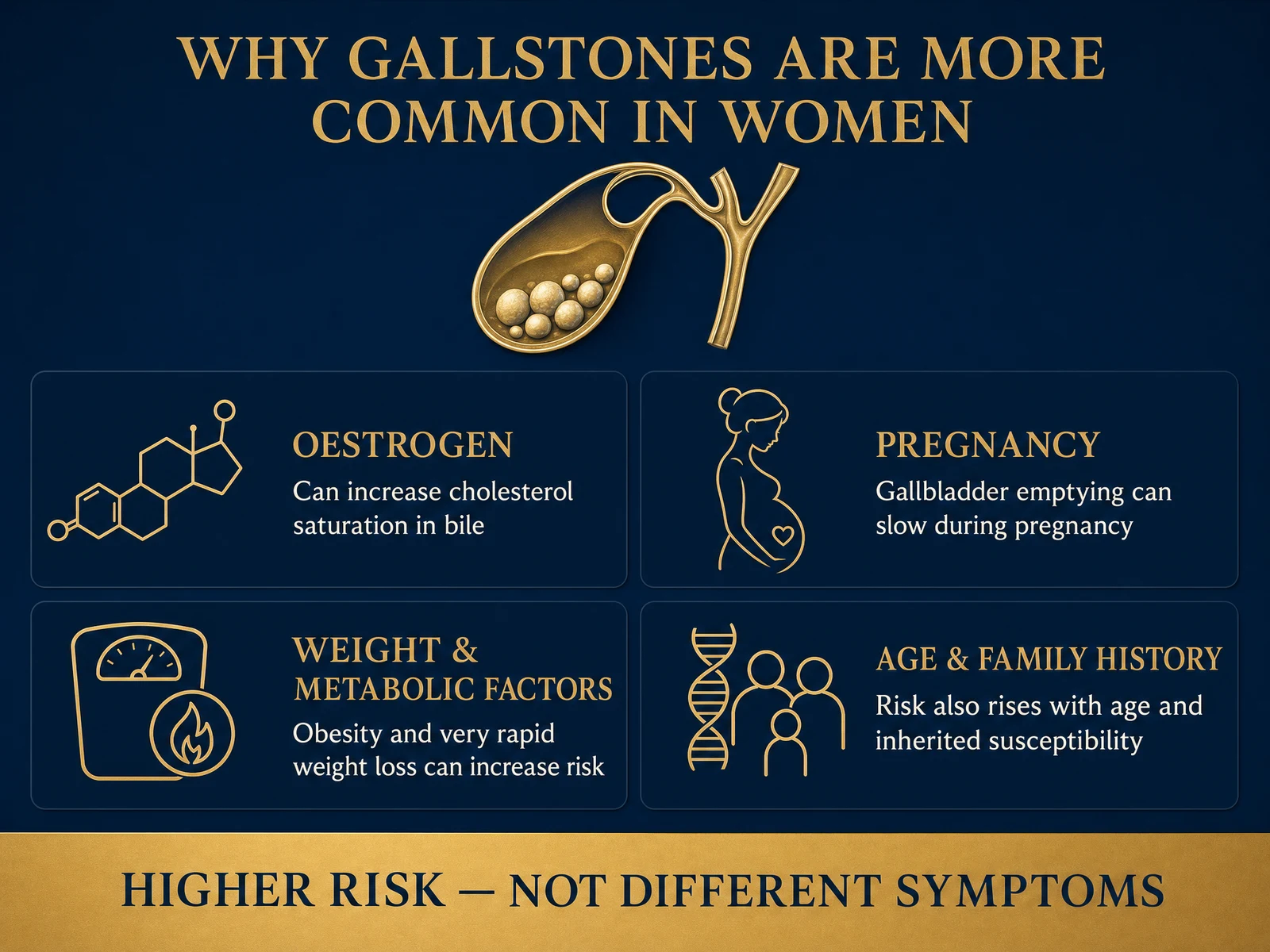
Women are roughly twice as likely as men to develop gallstones, and the hormone oestrogen is an important reason, as summarised in research on oestrogen and gallstone formation. In plain terms, oestrogen can make bile more saturated with cholesterol — the raw material of the most common gallstones — and can slow the gallbladder's emptying, which lets bile sit and thicken into sludge before it forms stones.
It helps to separate the risk factors you cannot change from those you can. In the epidemiology of gallbladder disease, the main non-modifiable factors are older age, female sex, ethnic background and family history, while the main modifiable ones are obesity, very rapid weight loss and a sedentary lifestyle. In other words, being a woman is one piece of the picture — not a verdict — and several of the other pieces are within your influence. Our guide to what causes gallstones covers the full list and what can help.
Pregnancy, hormones and the contraceptive pill
Because oestrogen plays a role, it is fair to ask about pregnancy and hormonal medicines — but the details matter, and they are easy to overstate.
Pregnancy does raise the risk. During pregnancy the gallbladder empties more slowly, and in one study of healthy pregnant women about 6% developed new gallstones and about 11% developed biliary sludge over the course of the pregnancy. Most of the time this causes no lasting problem, but gallbladder symptoms in pregnancy do deserve proper assessment — we cover this separately in gallstones in pregnancy.
Hormonal medicines are more nuanced than the stereotype suggests. A review of oestrogen therapy and gallbladder disease found that everyday combined oral contraceptives do not appear to raise gallbladder-disease risk meaningfully, whereas oestrogen taken as menopausal hormone-replacement therapy (HRT) is more clearly associated with it. None of this means you should stop a prescribed medicine on your own — it simply means these are sensible things to discuss with your doctor if you are getting gallbladder symptoms.
The old "fat, forty, fertile, female" mnemonic gets some of the risk factors right but is a blunt, outdated caricature. Plenty of women with gallstones fit none of it, and having a risk factor is not the same as having a problem.
When gallbladder pain is an emergency
Most gallbladder attacks settle on their own within a few hours. The important skill is telling an ordinary attack apart from the warning signs of a complication — when a stone causes lasting blockage or infection.
According to the NHS, seek urgent medical assessment if you have:
- Tummy pain that lasts more than a few hours or keeps getting worse
- A high temperature, fever or chills
- Yellowing of the skin or the whites of the eyes (jaundice)
- Repeated vomiting, or being unable to keep fluids down
- A racing heartbeat, confusion, or feeling very unwell
These can signal complications such as inflammation or infection of the gallbladder (acute cholecystitis), a blocked bile duct (which can cause jaundice or cholangitis), or inflammation of the pancreas (gallstone pancreatitis). In an emergency in the UAE, call 998 for an ambulance, or go to your nearest emergency department.
What to do next
If gallbladder-type pain keeps coming back — or you have had one severe attack — the sensible step is an assessment with an ultrasound to see whether gallstones are the cause and whether treatment is worthwhile. Recurrent attacks tend to continue, and there is no reliable way to "flush" or dissolve stones at home.
Dr Rajarshi Mitra can review your symptoms and scans, explain what your options are, and answer your questions calmly and clearly. If you would like that, you can book a consultation in Abu Dhabi. If surgery is ever the right choice, our guide to gallbladder removal in Abu Dhabi walks through what that involves.